What Should You Learn in a Finance Course for Beginners?

Financial statements, budgeting, cash flow management, and basic financial analysis are some of the fundamental concepts that need to be mastered before delving into specific topic areas, so first-time students in a finance course should learn these concepts. These core abilities equip the students to read, understand, and manage company performance and make informed financial decisions in accounting, banking, corporate finance and business management. 

Finance Course for Beginners

Finance Course for Beginners

What Is a Finance Course for Beginners?

A finance course for beginners is a structured training program designed to introduce core financial concepts to learners with little or no prior background in finance. This goes over financial statements, budgeting, forecasting, and basic financial analysis and shows it in a step-by-step format to give a practical understanding more than just theory.

These courses are designed for people working in the profession who deal with finance concepts in the workplace, rather than for an exam. A well-organized beginner programme integrates short courses, practical exercises and realistic scenarios, enabling learners to relate the things they learn to the business environment. Most programs are also modular, meaning that learners can move at their own speed, but still take a logical sequence of courses. 

Beginner Finance Topics

Topic Why It Matters
Financial Statements Understand business performance
Budgeting Plan financial resources
Forecasting Predict future performance
Cash Flow Monitor business liquidity

Why Is Financial Literacy the First Step?

Financial literacy is important first, since all other finance skills rely upon it. If a beginner does not understand the interdependence of revenue and cost, assets and liabilities, he/she will have a problem reading a report or participating effectively in a conversation about the finances in a workplace. Without this foundational understanding, basic things like a department budget review can become confusing.

Financial education also fosters confidence. When someone is equipped to be able to read a simple report and understand what the numbers represent, then they are much better prepared to do budgeting, forecasting and analytical work that will require more technical skill. This confidence builds up, as early success encourages learners to try more difficult work later. 

What Financial Statements Should Beginners Learn?

There are three basic financial statements that beginners should master: the income statement, the balance sheet and the cash flow statement. They all address a different business question, and collectively they provide a comprehensive view of the business performance and financial health.

The income statement indicates the profitability of a business over a time frame, the balance sheet represents the financial position of a business at a specific moment in time, and the cash flow statement shows how cash moves in and out of the business. Most conversations about finance at the job will reference at least one of these so beginning to read all three is a fundamental piece of a finance course for the novice. Those who can navigate the three statements will have a much better idea of the overall health of the business. 

Financial Statements Overview

Statement Purpose
Income Statement Measure profitability over a period
Balance Sheet Assess financial position at a point in time
Cash Flow Statement Track how cash moves through the business

How Does Budgeting Help Build Financial Skills?

Budgeting is a tool that benefits beginners in developing financial skills, as it enables them to distribute their resources on the priorities for their business. It will make students consider what is being traded off, timing, and accountability, all of which are essential elements of any financial or business position.

Budgeting exercises help beginners learn to set reasonable goals, monitor expenditures against the budget and to flag deviations early on. These practices carry over into the workplace, where the funds for the departments are allocated and subject to regular review. Learners also learn how to justify budget assumptions, which they will use in performance reviews and planning meetings. 

Why Is Forecasting Important for Finance Professionals?

Forecasting is essential because it moves money from reporting what has happened to predicting what will happen in the future. Forecasting is useful for beginners to learn to foresee income, costs and cash requirements, all of which help plan a business in all aspects.

A good financial planner can identify possible shortfalls in the future and make plans accordingly. This is a prime example of a skill that employers value in their entry-level finance hires and is one that will help you add value to the profession by thinking ahead instead of reacting. 

What Is Cash Flow Management and Why Does It Matter?

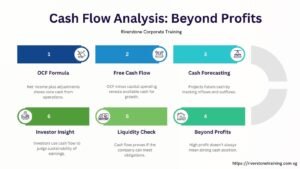
Cash flow management involves tracking, analysing and improving the flow of cash in and out of the business. It’s important because a business may appear profitable on paper, but find itself in serious cash flow trouble if it doesn’t have enough cash available to pay out its debts. A well-managed cash flow is essential to payroll, supplier payments and loan repayments.

If a person is familiar with cash flow management, he or she can anticipate trouble, including delayed collections or escalating short-term debt, before it becomes a problem. This is particularly useful in treasury, operations and small business finance positions where reported profit is less important than cash timing. 

How Do Beginners Learn Financial Analysis?

Students in this course will work with actual or simulated Company information to begin their financial analysis, beginning with ratio analysis and progressing to trend and variance analysis. The progression enables pupils to learn not only how to work out numbers but what they are used for in a business context.

Financial analysis training typically involves analyzing the actual results and identifying the reasons for the variance between the actual results and the budget, then communicating the results in a concise manner that will assist in decision-making. These exercises simulate the work a financial analyst does every day in a job in a business, such as with monthly reporting cycles or quarterly business reviews. 

What Excel Skills Should Finance Beginners Develop?

Before using complex financial models, finance beginners should learn the basics of Excel, which includes formulas, pivot tables, lookup functions and basic charting. They are the foundation of all of the day-to-day activities of financial management, ranging from budgeting to reporting, and are utilized in all industries and companies on a regular basis.

In addition to the functions, beginners can learn to set up a spreadsheet with a clear structure, label assumptions and develop simple models which can be followed by others. This is a useful habit in the profession of finance, as many people work on the same file. 

How Does Finance Support Better Business Decisions?

Finance enables improved decisions around the business by converting the business activity into numbers that the leaders can compare, evaluate and act upon. Financial analysis is used by a manager to make a decision on a new product that is being introduced, for example, whether it will cost less than what it is expected to return.

Newbies studying finance are taught to base choices on specific results and not on assumptions. This is one of the best reasons why finance knowledge is valuable, not just within the finance team, but across departments in a business when making decisions with data. 

What Common Mistakes Should Beginners Avoid?

Advanced modeling or forecasting should be reserved for the more advanced learner until the basics of financial statements and budgeting have been mastered. This can result in problems that are difficult to identify and track down the cause of once they arise later on in the project because the basics were not understood, or assumptions were incorrect.

One of the more common errors is to view finance as a set of formulas to memorize instead of a thought process for how to do business. It is important to teach learners not just to know the calculations, but what the numbers stand for; otherwise, they are not going to be able to use their learning in a real workplace where the context of the mathematical facts is as important as the facts themselves. 

How Does a Budgeting and Forecasting Course Improve Practical Skills?

A budgeting and forecasting course builds on foundational finance knowledge by teaching learners how to construct budgets, build rolling forecasts, and analyze variances in a structured, repeatable way. This brings learners from conceptual understanding to actual applications in planning cycles.

These courses usually involve real-life business contexts like budgeting for a department or a yearly plan and learners will be equipped with skills that can be readily put to use. This kind of course is suitable for students who have already mastered the basics, and it will take them one step closer to gaining real-world skills in the field of finance.

Budgeting and Forecasting Skills

Skill Workplace Application
Budget Planning Allocating resources across departments
Revenue Forecasting Projecting future sales and income
Expense Forecasting Anticipating and controlling costs
Variance Analysis Comparing actual results to plan

What Careers Can Beginners Pursue After Learning Finance?

After obtaining training in structured finance, beginning analysts can become financial analysts, accountants, treasury analysts, or even a corporate finance executive. All of these positions require the same core competencies for budgeting, forecasting and financial statement analysis.

This knowledge can also be applied to finance-related and non-finance-related careers, as almost every function will involve interpreting budgets or justifying financial data. Even for non-finance managers, this is a good base to build on when developing business cases or reviewing the spending of teams. 

Finance Career Pathways

Career Finance Skills Required
Financial Analyst Budgeting and forecasting
Accountant Financial statement reporting
Treasury Analyst Cash flow management
Corporate Finance Executive Financial planning and analysis

How Can Beginners Continue Developing Their Finance Knowledge?

Once the basics of finance are mastered, the beginner can advance to more in-depth study of finance, such as budgeting, forecasting, valuation and corporate finance. The advantage of this staged approach is that it doesn’t overwhelm the learner and also gives depth to the learning.

It’s also important to have “hands-on” experience. When students see a new skill in action in the real budgets, reports, or business cases they are working on at work, it reinforces the learning they acquired during class and it helps them remember what they learned much better than if they simply studied it. It also helps them learn from their more experienced peers and helps to speed up the learning curve.

What Skills Do Employers Expect From Entry-Level Finance Professionals?

Employers demand that entry-level finance workers be able to read financial statements accurately, create basic budgets and forecasts and be comfortable working with Excel for daily financial reporting needs. They are not advanced qualifications, but are expected to have them as part of the standard skill set for most job descriptions.

Communication skills are also important, as finance personnel should be able to communicate numbers in a relatively simple manner to non-finance personnel. Individuals who are beginning their careers and who have good technical skills and are able to communicate effectively are likely to make a difference early in their careers, especially if they are regularly reporting to a manager. 

Why Is Structured Finance Training Important for Long-Term Career Growth?

Structured finance training is crucial for long-term career growth because it provides a solid basis that will sustain all further phases of a finance career. Those who do not do structured learning often find that it leaves gaps which are only discovered later, when they are required to perform more complex duties.

An obvious progression of learning from basic to specialized courses also indicates to employers that the learner has demonstrated job-ready skills and not a set of disjointed informal tutorials. 

Summary: Finance Fundamentals for Beginners

Topic Why It Matters
Financial Statements Understand business performance and position
Budgeting Plan and allocate financial resources
Forecasting Predict future revenue, costs, and cash needs
Cash Flow Management Monitor business liquidity and stability
Financial Analysis Support informed business decision-making

Conclusion

It is recommended that beginners begin a finance course with the basics of financial statements, budgeting, forecasting, cash flow management and basic financial analysis before moving on to more advanced concepts. These skills provide the essential business acumen for analysing business performance and making informed decisions in any financial context. A finance course for beginners offers this foundation, while a budgeting and forecasting course builds on it to become an extension of the process of budgeting and forecasting into the analytical skills needed to aid in real business situations and decisions. The best way to do this is through some well-organized learning and to practice consistently and regularly. 
Frequently Asked Questions

What should beginners learn first in finance?

Before beginning to forecast or analyze financial statements, beginners should first learn how to read financial statements, create basic budgets, and understand cash flow. These are the foundation of all other finance skills and it’s the typical point of departure for beginners taking any finance course. 

Yes. A finance course for beginners is a course which is specifically designed for the learners who have a no idea regarding finance. The lessons follow a progression from simple to complex, including basic terminology and simple examples, and gradually introduced to budgeting, forecasting and analysis, and there is no prior finance background required to start the course. 

Budgeting and forecasting are vital as they enable businesses to plan their resources and resources usage, think about how they will perform in the future and make decisions in advance. These skills can be developed in a budgeting and forecasting course, and are essential in almost any career within finance. 

After taking finance course, one can find job as financial analyst, accountant, treasury analyst or corporate finance executive for beginners. The common thread throughout these career paths is financial statement analysis, budgeting and forecasting, which are introduced in the beginning of structured finance training. 

After a few weeks of being taught the fundamentals of finance, most learners will be able to understand the core concepts of financial statements and basic budgeting. Developing more in-depth forecasting and financial analysis skills generally requires more time and will require continuous, real-world practice. 

No, but it’s helpful to have a basic understanding of. For those just getting started in Finance, most beginner finance courses will cover the fundamental skills of Excel along with the basics of Finance, so the students can learn both at the same time instead of having to know Excel first. 

Financial statements, budgeting, cash flow management, and basic financial analysis are some of the fundamental concepts that need to be mastered before delving into specific topic areas, so first-time students in a finance course should learn these concepts. These core abilities equip the students to read, understand, and manage company performance and make informed financial decisions in accounting, banking, corporate finance and business management. 

Finance Course for Beginners

Finance Course for Beginners

What Is a Finance Course for Beginners?

A finance course for beginners is a structured training program designed to introduce core financial concepts to learners with little or no prior background in finance. This goes over financial statements, budgeting, forecasting, and basic financial analysis and shows it in a step-by-step format to give a practical understanding more than just theory.

These courses are designed for people working in the profession who deal with finance concepts in the workplace, rather than for an exam. A well-organized beginner programme integrates short courses, practical exercises and realistic scenarios, enabling learners to relate the things they learn to the business environment. Most programs are also modular, meaning that learners can move at their own speed, but still take a logical sequence of courses. 

Beginner Finance Topics

Topic Why It Matters
Financial Statements Understand business performance
Budgeting Plan financial resources
Forecasting Predict future performance
Cash Flow Monitor business liquidity

Why Is Financial Literacy the First Step?

Financial literacy is important first, since all other finance skills rely upon it. If a beginner does not understand the interdependence of revenue and cost, assets and liabilities, he/she will have a problem reading a report or participating effectively in a conversation about the finances in a workplace. Without this foundational understanding, basic things like a department budget review can become confusing.

Financial education also fosters confidence. When someone is equipped to be able to read a simple report and understand what the numbers represent, then they are much better prepared to do budgeting, forecasting and analytical work that will require more technical skill. This confidence builds up, as early success encourages learners to try more difficult work later. 

What Financial Statements Should Beginners Learn?

There are three basic financial statements that beginners should master: the income statement, the balance sheet and the cash flow statement. They all address a different business question, and collectively they provide a comprehensive view of the business performance and financial health.

The income statement indicates the profitability of a business over a time frame, the balance sheet represents the financial position of a business at a specific moment in time, and the cash flow statement shows how cash moves in and out of the business. Most conversations about finance at the job will reference at least one of these so beginning to read all three is a fundamental piece of a finance course for the novice. Those who can navigate the three statements will have a much better idea of the overall health of the business. 

Financial Statements Overview

Statement Purpose
Income Statement Measure profitability over a period
Balance Sheet Assess financial position at a point in time
Cash Flow Statement Track how cash moves through the business

How Does Budgeting Help Build Financial Skills?

Budgeting is a tool that benefits beginners in developing financial skills, as it enables them to distribute their resources on the priorities for their business. It will make students consider what is being traded off, timing, and accountability, all of which are essential elements of any financial or business position.

Budgeting exercises help beginners learn to set reasonable goals, monitor expenditures against the budget and to flag deviations early on. These practices carry over into the workplace, where the funds for the departments are allocated and subject to regular review. Learners also learn how to justify budget assumptions, which they will use in performance reviews and planning meetings. 

Why Is Forecasting Important for Finance Professionals?

Forecasting is essential because it moves money from reporting what has happened to predicting what will happen in the future. Forecasting is useful for beginners to learn to foresee income, costs and cash requirements, all of which help plan a business in all aspects.

A good financial planner can identify possible shortfalls in the future and make plans accordingly. This is a prime example of a skill that employers value in their entry-level finance hires and is one that will help you add value to the profession by thinking ahead instead of reacting. 

What Is Cash Flow Management and Why Does It Matter?

Cash flow management involves tracking, analysing and improving the flow of cash in and out of the business. It’s important because a business may appear profitable on paper, but find itself in serious cash flow trouble if it doesn’t have enough cash available to pay out its debts. A well-managed cash flow is essential to payroll, supplier payments and loan repayments.

If a person is familiar with cash flow management, he or she can anticipate trouble, including delayed collections or escalating short-term debt, before it becomes a problem. This is particularly useful in treasury, operations and small business finance positions where reported profit is less important than cash timing. 

How Do Beginners Learn Financial Analysis?

Students in this course will work with actual or simulated Company information to begin their financial analysis, beginning with ratio analysis and progressing to trend and variance analysis. The progression enables pupils to learn not only how to work out numbers but what they are used for in a business context.

Financial analysis training typically involves analyzing the actual results and identifying the reasons for the variance between the actual results and the budget, then communicating the results in a concise manner that will assist in decision-making. These exercises simulate the work a financial analyst does every day in a job in a business, such as with monthly reporting cycles or quarterly business reviews. 

What Excel Skills Should Finance Beginners Develop?

Before using complex financial models, finance beginners should learn the basics of Excel, which includes formulas, pivot tables, lookup functions and basic charting. They are the foundation of all of the day-to-day activities of financial management, ranging from budgeting to reporting, and are utilized in all industries and companies on a regular basis.

In addition to the functions, beginners can learn to set up a spreadsheet with a clear structure, label assumptions and develop simple models which can be followed by others. This is a useful habit in the profession of finance, as many people work on the same file. 

How Does Finance Support Better Business Decisions?

Finance enables improved decisions around the business by converting the business activity into numbers that the leaders can compare, evaluate and act upon. Financial analysis is used by a manager to make a decision on a new product that is being introduced, for example, whether it will cost less than what it is expected to return.

Newbies studying finance are taught to base choices on specific results and not on assumptions. This is one of the best reasons why finance knowledge is valuable, not just within the finance team, but across departments in a business when making decisions with data. 

What Common Mistakes Should Beginners Avoid?

Advanced modeling or forecasting should be reserved for the more advanced learner until the basics of financial statements and budgeting have been mastered. This can result in problems that are difficult to identify and track down the cause of once they arise later on in the project because the basics were not understood, or assumptions were incorrect.

One of the more common errors is to view finance as a set of formulas to memorize instead of a thought process for how to do business. It is important to teach learners not just to know the calculations, but what the numbers stand for; otherwise, they are not going to be able to use their learning in a real workplace where the context of the mathematical facts is as important as the facts themselves. 

How Does a Budgeting and Forecasting Course Improve Practical Skills?

A budgeting and forecasting course builds on foundational finance knowledge by teaching learners how to construct budgets, build rolling forecasts, and analyze variances in a structured, repeatable way. This brings learners from conceptual understanding to actual applications in planning cycles.

These courses usually involve real-life business contexts like budgeting for a department or a yearly plan and learners will be equipped with skills that can be readily put to use. This kind of course is suitable for students who have already mastered the basics, and it will take them one step closer to gaining real-world skills in the field of finance.

Budgeting and Forecasting Skills

Skill Workplace Application
Budget Planning Allocating resources across departments
Revenue Forecasting Projecting future sales and income
Expense Forecasting Anticipating and controlling costs
Variance Analysis Comparing actual results to plan

What Careers Can Beginners Pursue After Learning Finance?

After obtaining training in structured finance, beginning analysts can become financial analysts, accountants, treasury analysts, or even a corporate finance executive. All of these positions require the same core competencies for budgeting, forecasting and financial statement analysis.

This knowledge can also be applied to finance-related and non-finance-related careers, as almost every function will involve interpreting budgets or justifying financial data. Even for non-finance managers, this is a good base to build on when developing business cases or reviewing the spending of teams. 

Finance Career Pathways

Career Finance Skills Required
Financial Analyst Budgeting and forecasting
Accountant Financial statement reporting
Treasury Analyst Cash flow management
Corporate Finance Executive Financial planning and analysis

How Can Beginners Continue Developing Their Finance Knowledge?

Once the basics of finance are mastered, the beginner can advance to more in-depth study of finance, such as budgeting, forecasting, valuation and corporate finance. The advantage of this staged approach is that it doesn’t overwhelm the learner and also gives depth to the learning.

It’s also important to have “hands-on” experience. When students see a new skill in action in the real budgets, reports, or business cases they are working on at work, it reinforces the learning they acquired during class and it helps them remember what they learned much better than if they simply studied it. It also helps them learn from their more experienced peers and helps to speed up the learning curve.

What Skills Do Employers Expect From Entry-Level Finance Professionals?

Employers demand that entry-level finance workers be able to read financial statements accurately, create basic budgets and forecasts and be comfortable working with Excel for daily financial reporting needs. They are not advanced qualifications, but are expected to have them as part of the standard skill set for most job descriptions.

Communication skills are also important, as finance personnel should be able to communicate numbers in a relatively simple manner to non-finance personnel. Individuals who are beginning their careers and who have good technical skills and are able to communicate effectively are likely to make a difference early in their careers, especially if they are regularly reporting to a manager. 

Why Is Structured Finance Training Important for Long-Term Career Growth?

Structured finance training is crucial for long-term career growth because it provides a solid basis that will sustain all further phases of a finance career. Those who do not do structured learning often find that it leaves gaps which are only discovered later, when they are required to perform more complex duties.

An obvious progression of learning from basic to specialized courses also indicates to employers that the learner has demonstrated job-ready skills and not a set of disjointed informal tutorials. 

Summary: Finance Fundamentals for Beginners

Topic Why It Matters
Financial Statements Understand business performance and position
Budgeting Plan and allocate financial resources
Forecasting Predict future revenue, costs, and cash needs
Cash Flow Management Monitor business liquidity and stability
Financial Analysis Support informed business decision-making

Conclusion

It is recommended that beginners begin a finance course with the basics of financial statements, budgeting, forecasting, cash flow management and basic financial analysis before moving on to more advanced concepts. These skills provide the essential business acumen for analysing business performance and making informed decisions in any financial context. A finance course for beginners offers this foundation, while a budgeting and forecasting course builds on it to become an extension of the process of budgeting and forecasting into the analytical skills needed to aid in real business situations and decisions. The best way to do this is through some well-organized learning and to practice consistently and regularly. 

Frequently Asked Questions

What should beginners learn first in finance?

Before beginning to forecast or analyze financial statements, beginners should first learn how to read financial statements, create basic budgets, and understand cash flow. These are the foundation of all other finance skills and it’s the typical point of departure for beginners taking any finance course. 

Yes. A finance course for beginners is a course which is specifically designed for the learners who have a no idea regarding finance. The lessons follow a progression from simple to complex, including basic terminology and simple examples, and gradually introduced to budgeting, forecasting and analysis, and there is no prior finance background required to start the course. 

Budgeting and forecasting are vital as they enable businesses to plan their resources and resources usage, think about how they will perform in the future and make decisions in advance. These skills can be developed in a budgeting and forecasting course, and are essential in almost any career within finance. 

After taking finance course, one can find job as financial analyst, accountant, treasury analyst or corporate finance executive for beginners. The common thread throughout these career paths is financial statement analysis, budgeting and forecasting, which are introduced in the beginning of structured finance training. 

After a few weeks of being taught the fundamentals of finance, most learners will be able to understand the core concepts of financial statements and basic budgeting. Developing more in-depth forecasting and financial analysis skills generally requires more time and will require continuous, real-world practice. 

No, but it’s helpful to have a basic understanding of. For those just getting started in Finance, most beginner finance courses will cover the fundamental skills of Excel along with the basics of Finance, so the students can learn both at the same time instead of having to know Excel first. 

Related Posts

Everything You Need to Know About Finance Courses

Advance your career with Riverstone’s expert-led finance courses. Get in touch with us now.