A CFA preparation course enhances the ability of students to be better prepared for the exams by reinforcing financial analysis and valuation, portfolio management, ethics, and quantitative methods through systematic study and practice. By following a structured CFA preparation course, candidates develop the technical knowledge, exam approach, and timidness that they need to perform with confidence and confidence in their technical knowledge of finance that will be applicable to their work in the future.
What Is a CFA Preparation Course?
A CFA preparation course is a structured training program that guides candidates through the Chartered Financial Analyst curriculum, covering financial analysis, valuation, portfolio management, and ethics in an organized, exam-focused format. It involves conceptual learning as well as question practice, practice test questions and practice test papers to develop knowledge and exam technique.
Instead of having students read through complex curriculum texts on their own, a preparation course organizes material into small chunks and provides clear learning goals. Teachers emphasize key points, frequently asked questions on the exams, and useful tips for calculations that can be missed in self-study.
Why Is Structured Exam Preparation Important?
The importance of structured exam preparation cannot be overstated, as the CFA curriculum covers many finance-related topics, and it is easy to study them unevenly, leaving some topics undercovered and others over-covered. A defined study sequence allows candidates to develop basic concepts before moving on to the more complex applications.
If a candidate learns quantitative methods before tackling portfolio management problems, he/she is more able to correctly interpret outputs from statistics. There is also some structure of preparation which helps develop pacing discipline, assisting candidates to deal with the time challenge the format requires for the examination.
What Finance Topics Should Candidates Master First?
Ethics, quantitative methods and financial statement analysis should be mastered first, as they represent the analytical backbone of most of the other topics of the curriculum. The weaknesses of these fundamentals build into difficulty in corporate finance, equity valuation and fixed income sections during preparation.
CFA Curriculum Topics
| Topic | Why It Matters |
| Ethics | Guides professional decision-making and judgment |
| Financial Statement Analysis | Evaluates company performance and accounting quality |
| Portfolio Management | Builds investment strategy and asset allocation skills |
| Equity Valuation | Supports business and security valuation |
| Fixed Income | Develops bond pricing and credit analysis skills |
Early attention should be given to economics, as topics like the behavior of interest rates and market equilibrium will be seen again in portfolio management and in fixed-income topics. This type of study sequence reflects the thought of practicing analysts, who first develop the technical skills before making an investment decision.
How Does Financial Statement Analysis Improve Exam Performance?
Financial statement analysis is an area of exam performance that is trained and tested extensively in the exams across all levels, and helps candidates to analyze the income statements, balance sheet and cash flow statements accurately. A good understanding of accounting adjustments and ratio analysis also aids in answering questions on equity valuation and credit analysis.
For example, when evaluating the accounting method used for inventory, a candidate will need to be able to explain how the decision is likely to affect the earnings reported and the comparability of the company with its peers. Repeatedly practicing these adjustments helps develop the speed and accuracy required to correctly answer questions on statement analysis given the timed conditions.
Why Is Ethics a Core Component of CFA Preparation?
Ethics is an important part of the CFA preparation because marginal candidates often excel in this section of the exam, with emphasis on the Code of Ethics and Standards of Professional Conduct. Ethics questions evaluate judgment based on real-life situations in the workplace, rather than rules memorized from a book.
The portfolio manager who doesn’t tell clients about the conflict of interest before suggesting an investment is a good example of a scenario that candidates can expect to analyse correctly. Ethics is a significant part of preparation courses, since the scores made here will have a significant impact on the overall exam performance.
How Does Portfolio Management Build Investment Skills?

Portfolio management develops investment skills by guiding the candidate in the construction, monitoring and adjustment of an investment portfolio according to the client’s investment goals, risk appetite and market conditions. This subject covers equity, fixed income and alternative investments within a unified decision-making process.
A candidate learning strategic asset allocation, for instance, does that by balancing expected returns with constraints on risk to satisfy an investor’s investment policy statement. Portfolio management is one of the most career-relevant parts of the curriculum, as the exercises are based on real tasks performed by asset managers and wealth advisors.
What Role Does Quantitative Analysis Play in CFA Studies?
The quantitative analysis is an integral part of CFA studies and is the first step in learning statistical and probability tools to assess investment returns, investment risk, and hypothesis testing throughout the course. The topics that follow make extensive references to concepts that are discussed in this concept.
For example, if a candidate is calculating the expected return and standard deviation of a portfolio consisting of two assets, they are using quantitative techniques in the context of a portfolio management problem. Good quantitative fluency minimises calculation mistakes, which can end up costing candidates points in several parts of the paper.
How Does Financial Management Support Investment Decisions?
Financial management is a component that aids in making investment decisions by providing the tools that are used to analyze capital budgeting options, to manage cash flow and the corporate financing structure that directly influence the company’s value. A financial management course supports these concepts and enhances candidates’ competency in implementing principles of capital budgeting, financial planning and cash flow management, all of which support the study of the CFA.
Financial Management Skills
| Skill | Workplace Application |
| Capital Budgeting | Evaluating investment and expansion decisions |
| Cash Flow Analysis | Supporting financial planning and forecasting |
| Risk Assessment | Informing portfolio and credit decisions |
| Financial Analysis | Assessing business performance and valuation |
Net present value and internal rate of return are techniques used by an analyst to determine if a company should undertake a capital expansion project, based on financial management principles. These skills are the same skills that are directly applicable to corporate finance and equity valuation questions of the CFA exam.
How Can Practice Questions Improve Exam Readiness?
Practice questions help candidates become familiar with the type of questions, phrasing and time limits they will encounter on exam day and also develop some pacing discipline. Through repeated practice, it is also possible to uncover knowledge gaps that are not necessarily obvious when reading silently.
Exam Preparation Strategy
| Activity | Benefit |
| Practice Questions | Improve problem-solving speed and accuracy |
| Mock Exams | Build exam confidence and pacing discipline |
| Revision Schedule | Strengthen knowledge retention over time |
| Formula Review | Improve calculation accuracy under time pressure |
Under timed conditions, candidates are trained to glean relevant data from dense case scenarios, for instance, in vignette-based item sets. Caringly reading over the wrong answers is what makes practice exam-ready.
What Common Mistakes Should CFA Candidates Avoid?
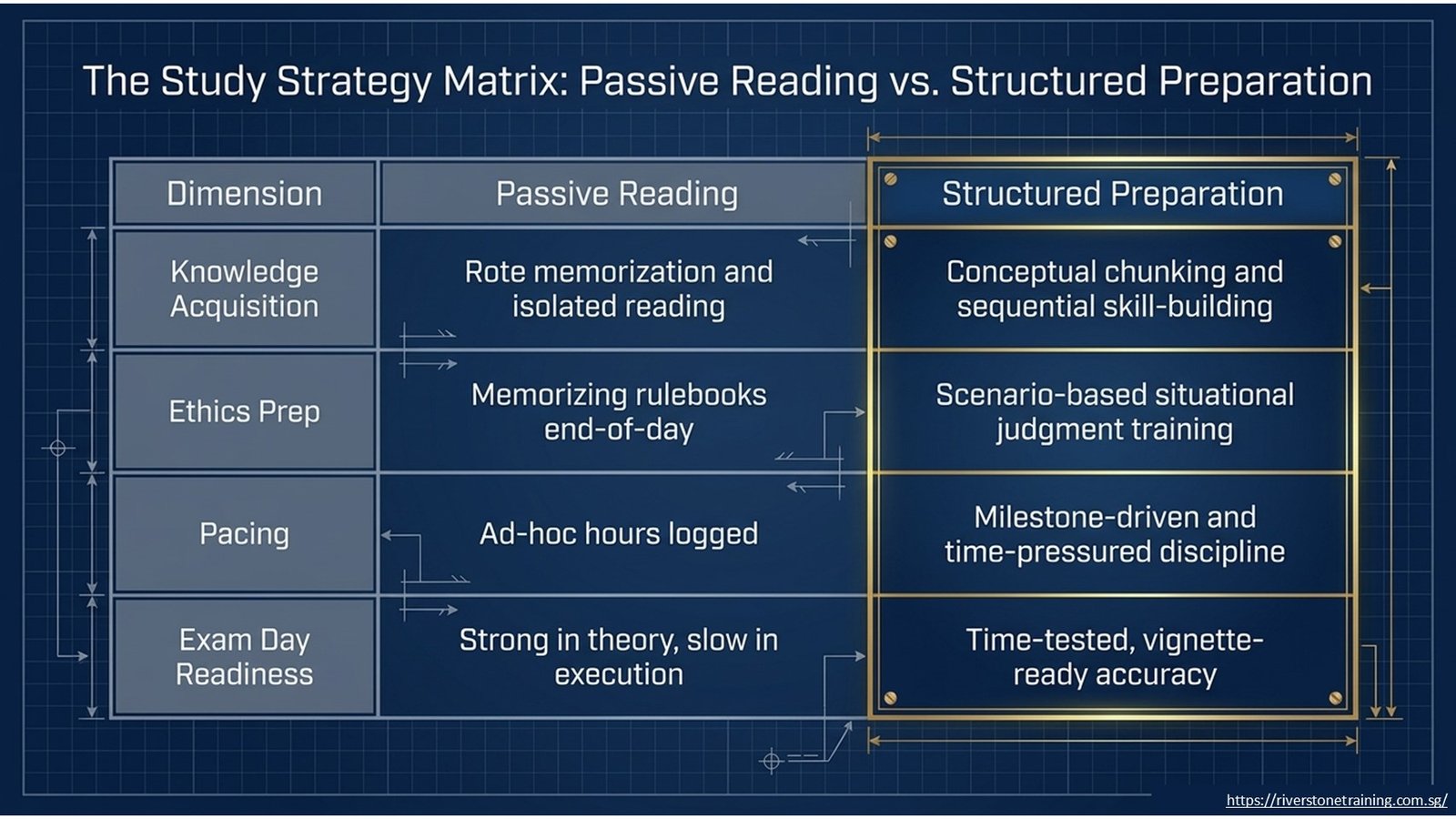
CFA candidates should not take the ethics section lightly, only passively read the material, and cram for the end of the day. The errors often result in differing readiness in topic areas that emerge in the real test situation.
Another common failing is to forget the formula under timed conditions – a candidate may know how to do a concept in theory but have trouble remembering it quickly when it comes to the exam. Structured preparation courses address these errors directly in the following ways: through paced study plans and regular self-assessment.
How Does a Financial Management Course Complement CFA Preparation?
A financial management course complements the CFA coursework by reinforcing the fundamental concepts of corporate finance, which directly interface with the CFA coursework, like capital budgeting, financial planning and strategic decision making. This extra depth will reinforce the understanding of concepts beyond exam memorization.
A finance management student who has learned about cash flow forecasting and capital structure management would have a better sense of practical intuition for related questions of CFA corporate finance. The blend of this will develop skills that will be applicable on exam day and beyond in the workplace.
What Careers Benefit from CFA Knowledge?
Anywhere professionals need to evaluate investments or allocate capital to them, their careers are enriched by CFA knowledge. The breadth of the curriculum places it beyond traditional portfolio management applications.
Finance Career Pathways
| Career | Key Finance Skills |
| Financial Analyst | Financial statement and ratio analysis |
| Investment Analyst | Valuation and portfolio management |
| Asset Manager | Investment strategy and asset allocation |
| Corporate Finance Professional | Capital allocation and budgeting |
| Risk Manager | Quantitative analysis and risk assessment |
When constructing financial models in equity research or providing investment recommendations, an equity research analyst uses the valuation techniques he or she practiced during the preparation for the CFA exam, and when determining exposures for a portfolio, a risk manager uses quantitative techniques. The flexibility of this is one of the reasons why it is still respected in all areas of the finance sector.
How Can Learners Stay Consistent Throughout Their Preparation?
Using a realistic study plan, weekly topic planning, and comparing study progress with practice exam results, rather than time spent studying, allows learners to remain consistent throughout preparation. Regular, intensive study sessions are not necessary for long-term memory; consistency is more important.
Encouraging learners to tackle a smaller weekly target – e.g. to finish the practice questions for one topic area before the next – keeps them going for many months of preparation. Structured courses help to ensure this consistency by offering a structured syllabus and progression milestones that candidates can work through.
Why Is Practical Finance Knowledge Important Beyond the Exam?
Practical finance knowledge is relevant outside the exam as employers are more interested in the candidate being able to apply the concepts of valuation, portfolio management and financial analysis to actual work tasks rather than simply regurgitate exam answers. The credential represents competent performance, and performance on the job is built on the application of understanding.
Any newly certified analyst with the ability to create a discounted cash flow model or evaluate the credit risk of a bond is worth more than just someone who knows these terms from exam questions. That’s why the best preparation courses for CFA have a structured approach with an emphasis on application rather than memorization.
How Can Continuous Learning Support Long-Term Finance Careers?
Continuous learning helps professionals stay up-to-date with constantly changing markets, regulations, and analytical methods, which go well beyond the scope of any single credential, thereby helping them maintain their finance careers in the long run. In finance, practical knowledge is a skill that needs to be constantly nurtured, not simply obtained through an award.
Summary: CFA Preparation at a Glance
| Preparation Element | Key Takeaway |
| Structured Study | Builds coverage discipline across the full curriculum |
| Ethics Focus | Strengthens scenario-based judgment and scoring |
| Practice & Mock Exams | Converts knowledge into exam-day performance |
| Financial Management Reinforcement | Deepens practical application of core concepts |
Conclusion
The CFA preparation course helps make students exam-ready by developing the ability to build structured mastery of the areas of financial analysis, ethics, portfolio management and quantitative analysis, and to reinforce the study discipline required to excel under exam conditions. The technical ability and test-taking knowledge that clearly differentiate well-prepared test takers from those who attempt to study on their own make the difference in this area.
A CFA preparation course will provide the analytical and technical knowledge needed to pursue a financial career, and a financial management course will build core financial planning, capital budgeting and business decision-making skills that will be valuable to candidates for a financial career beyond the CFA exam.
You can only achieve success in exams and excel in your profession through practice and application, not knowledge. For those studying for the CFA exam, structured finance training should be complemented by frequent practice questions, mock exams, and real-world projects to foster a rich and enduring base of finance knowledge that is applicable to career success.