An IFRS finance course gives professionals the ability to apply accounting standards, prepare precise financial statements, improve disclosure, and boost compliance. It develops technical capability to create reports to meet regulatory needs and support decision-making and stakeholder trust.
What Is an IFRS Finance Course?
IFRS finance course is a systematic training course to teach finance professionals to prepare, present, and analyze financial accounts under IFRS. It includes the basics of revenue recognition, fair value measurement, lease accounting, financial instruments, and asset valuation, with a focus on both the theory and application skills.
These programs appeal to accountants, financial controllers, financial managers, auditors, and financial analysts who prepare and/or review financial statements in jurisdictions that have implemented IFRS. The course builds competency to apply standards consistently and accurately, minimize the likelihood of misreporting, and enhance the quality of financial reporting at the organization.
Why Is IFRS Important for Financial Reporting?
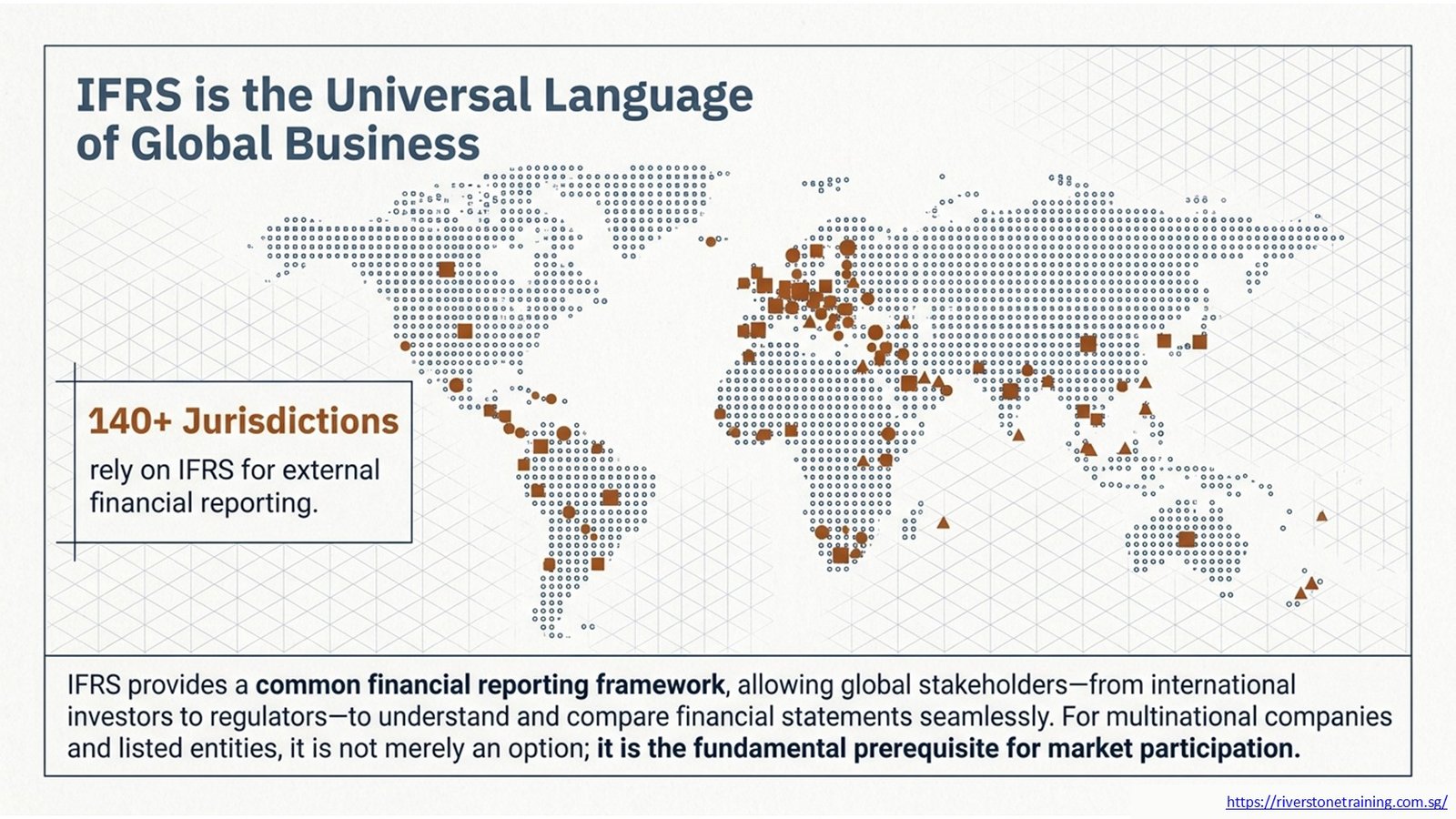
IFRS offers a worldwide financial reporting framework that helps organizations in diverse jurisdictions to be consistent, comparable, and transparent in their business and financial reporting. The IFRS requirements are an essential element for businesses that are subject to reporting to international investors, listed, and multinational companies. IFRS financial statements facilitate understanding and comparison of financial statements by stakeholders globally, enhancing the value and confidence of the information provided.
The need for IFRS goes beyond mere compliance. The IFRS accounting standards, such as IFRS 15 (revenue recognition), IFRS 16 (leases), and IFRS 9 (financial instruments), significantly influence the reporting of financial performance and position. Financial professionals who lack knowledge of these standards could be liable for reporting inaccuracies, committing wrong accounting decisions, and facing audit results and compliance issues.
Table 1: IFRS Reporting Benefits
| Benefit | Practical Impact | Stakeholder Relevance |
| Consistency | Comparable financial reporting across periods | Investors and analysts |
| Transparency | Clearer disclosure of financial position | Regulators and shareholders |
| Accuracy | Reduced reporting errors and misstatements | Auditors and boards |
| Compliance | Reduced regulatory and audit risk | Finance and legal teams |
| Credibility | Stronger stakeholder and investor trust | Capital markets and lenders |
| Comparability | Benchmarking against industry peers | Management and analysts |
How Does IFRS Improve Financial Statement Consistency?
IFRS enhances the consistency of financial statements by creating uniformity in recognition, measurement and presentation principles that are implemented over time and from entity to entity. Financial statements prepared on a consistent basis are useful for comparing from year to year as a company uses the IFRS; this allows analysts, investors, and management to detect genuine year-to-year performance trends instead of year-to-year shifts attributable to accounting policy changes.
Also, consistency helps in group reporting in multicultural organizations. Consolidated financial statements are more reliable and less likely to be affected by different local accounting policies when all subsidiaries use the same IFRS policies. Compliance with IFRS by Finance professionals involves consistent application of the standards and the recording of accounting policy decisions that facilitate audit review and regulatory examination.
How Can Finance Professionals Apply IFRS Standards in Daily Work?
The IFRS standards are used by finance professionals in various everyday situations, such as classification of financial instruments, lease accounting, expense categorization, asset valuation, and revenue recognition. Whether you’re a finance manager reviewing a contract for embedded lease components, a controller applying IFRS 15 to determine when revenue is considered to have been earned, or a controller applying IFRS 15 to measure a financial asset at fair value, you need practical knowledge of IFRS to do this correctly.
The application of IFRS also requires judgment in some areas where the standard allows for alternative treatments and/or estimation. Finance professionals who grasp the underlying principles behind each standard – not just how to apply the mechanics – can make more consistent and defensible accounting decisions. One of the major skills that come out of structured IFRS training programs is a judgment-based competency.
How Does IFRS Strengthen Financial Statement Accuracy?
The proper application of recognition and measurement criteria is essential to the accuracy of financial statements. IFRS offers some guidance on the recognition of assets, liabilities, income and expenses and how they are to be measured and presented. The more a finance professional is familiar with these criteria, the less likely they are to misclassify transactions, use the wrong measurement basis, or fail to disclose. Having knowledge of these criteria helps finance professionals to avoid misclassifying transactions, applying inappropriate measurement bases, or failing to disclose required information, all of which can negatively affect accuracy in the reporting.
Financial reporting problems are typically caused by inadequate application of IFRS standards, including premature revenue recognition, lease capitalization, or the misstatement of the values of financial instruments. Training directly addresses the gaps by providing explanations of the conditions that need to be met for the recognition of material items, and of the measurement approaches required under each of the standards, limiting the occurrence of material errors in reported financial statements.
Table 2: Financial Reporting Skills Developed Through IFRS Training
| Skill | Workplace Application | Reporting Benefit |
| Financial Statement Preparation | Producing compliant and accurate reports | Improved reporting quality |
| Disclosure Management | Drafting compliant notes to accounts | Stronger compliance and transparency |
| Financial Analysis | Interpreting IFRS-based financial data | Better-informed decision-making |
| Audit Readiness | Documenting accounting judgments | Smoother audit processes |
| Fair Value Measurement | Valuing assets and liabilities correctly | Accurate balance sheet reporting |
| Revenue Recognition | Applying IFRS 15 contract analysis | Reliable income statement reporting |
What Role Does Fair Value Measurement Play in IFRS Reporting?
The fair value concept is one of the fundamental concepts in IFRS, which mandates that many assets and liabilities be measured at the price received in an orderly sale of an asset and paid in an orderly transfer of a liability. IFRS 13 establishes a framework to consistently apply fair value measurement, with a three-level hierarchy that ranks the inputs used based on whether they are observable in the market or based on estimates.
The finance profession with knowledge of the fair value principles will be better able to measure investment properties, financial instruments, biological assets, and other assets that need to be revalued periodically. Errors in fair value accounting can have a significant impact on the balance sheet and income statement and result in audit adjustments, investor concerns, and errors. IFRS Training builds technical skills to use fair value measurement approaches appropriately and records the basis of estimates for audit & disclosure.
How Does IFRS Improve Financial Disclosure Quality?
Effective financial disclosures enable stakeholders to see more than the primary financial statements, and they give them information to help them understand the financial position, performance, and risks of an organization. There are many disclosures required in the notes to the financial statements, including accounting policies, significant estimates and judgments, risk exposures and disaggregated financial information, that are required under IFRS. IFRS-trained finance experts know what information needs to be disclosed and how to do it effectively and comprehensively.
Low-quality disclosures are often the cause of audit findings and regulatory comment. There is a risk of missing sensitivity analysis of key estimates, incomplete information on financial instrument risks, and/or insufficient explanation of accounting policies. IFRS training assists finance professionals with identifying disclosures in a systematic manner and prepares them to draft the disclosure in regulatory-compliant language before they go out in public financial statements for disclosure completeness.
Table 3: Common IFRS Applications in the Workplace
| IFRS Area | Standard | Practical Use |
| Revenue Recognition | IFRS 15 | Determining when and how to record sales revenue |
| Fair Value Measurement | IFRS 13 | Valuing investments, properties, and financial assets |
| Lease Accounting | IFRS 16 | Capitalizing lease liabilities and right-of-use assets |
| Financial Instruments | IFRS 9 | Classifying and measuring debt and equity instruments |
| Impairment of Assets | IAS 36 | Testing assets for impairment and recording write-downs |
| Employee Benefits | IAS 19 | Measuring and disclosing pension and benefit obligations |
How Can IFRS Knowledge Support Better Financial Analysis?
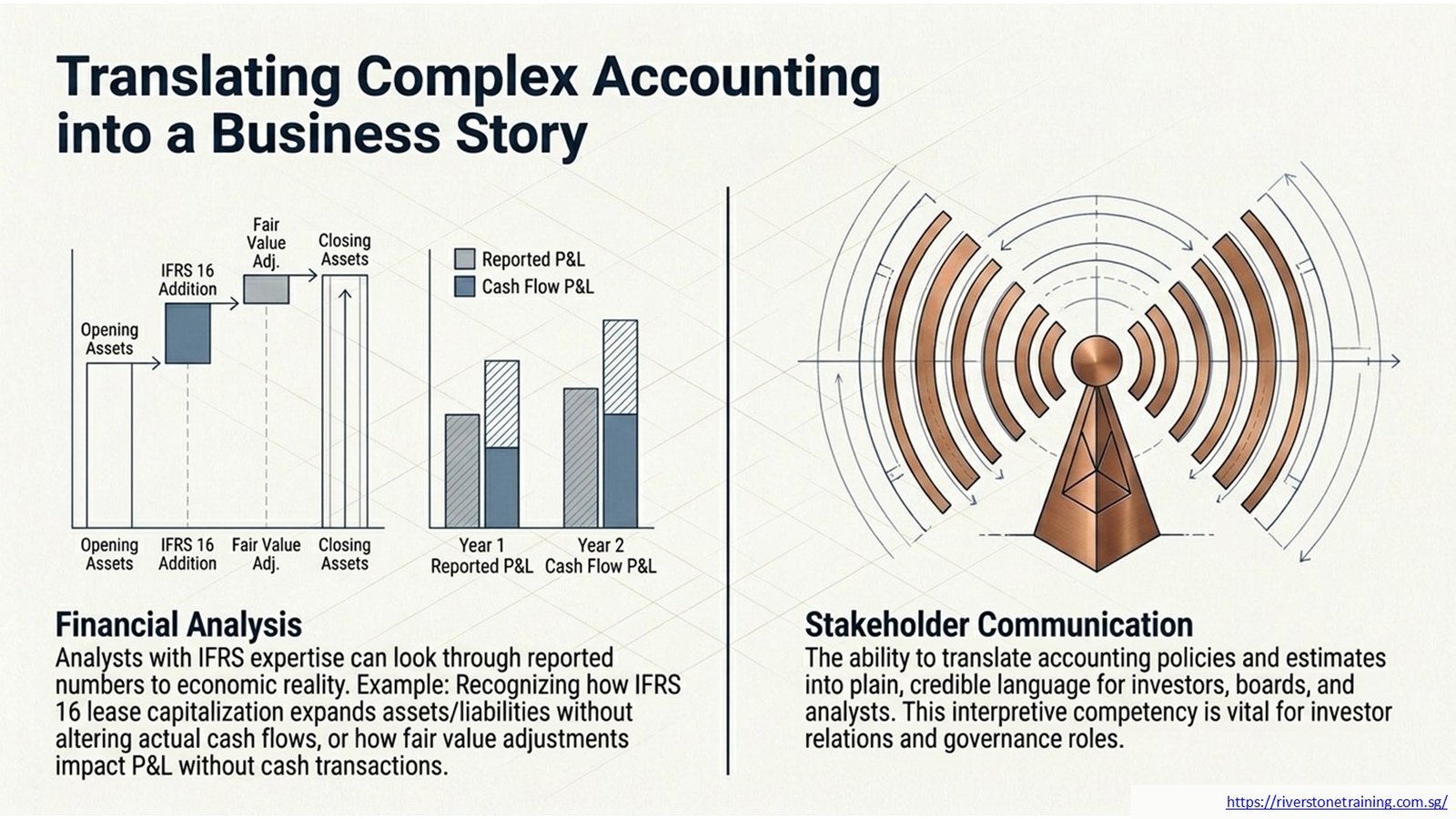
The quality and comparability of underlying financial data are fundamental to financial analysis. Using a set of analytical tools developed by those who understand IFRS, analysts can see more clearly what is happening to reported numbers: For example, the change for IFRS 16 capitalization of leases expands assets and liabilities but doesn’t change cash flows; or, the change for fair value in financial instruments has an impact on the P&L without a cash transaction. This interpretive competency results in better analysis and better conclusions.
If you are a finance professional who creates management reports, presentations for investors, or papers for your board based on the IFRS financial statements, it is important to understand the link between accounting standards and the numbers that are reported. Those who know the IFRS can convert accounting results into a business story, understand the accounting issues behind variances, and report financial results with credibility to those who are not accounting professionals.
How Does IFRS Help Organizations Meet Compliance Requirements?
Listed companies and entities in jurisdictions where adoption of IFRS is required to be compliant with IFRS standards. A qualified audit opinion, regulatory enforcement, inquiries to the stock exchange, and investor confidence concerns can all be risks if organizations do not apply IFRS properly. Compliance teams that are well-trained in standards that apply can more effectively and consistently meet compliance requirements.
Compliance with IFRS also gives an indication of good internal governance as the financial statements presented to the board and audit committee are accurate and in accordance with IFRS. Once compliance with each applicable standard is known by a finance professional, remediation costs are minimized, and standards are met or exceeded during the reporting process, before fieldwork has started for the audit.
What Common Financial Reporting Challenges Can IFRS Training Address?
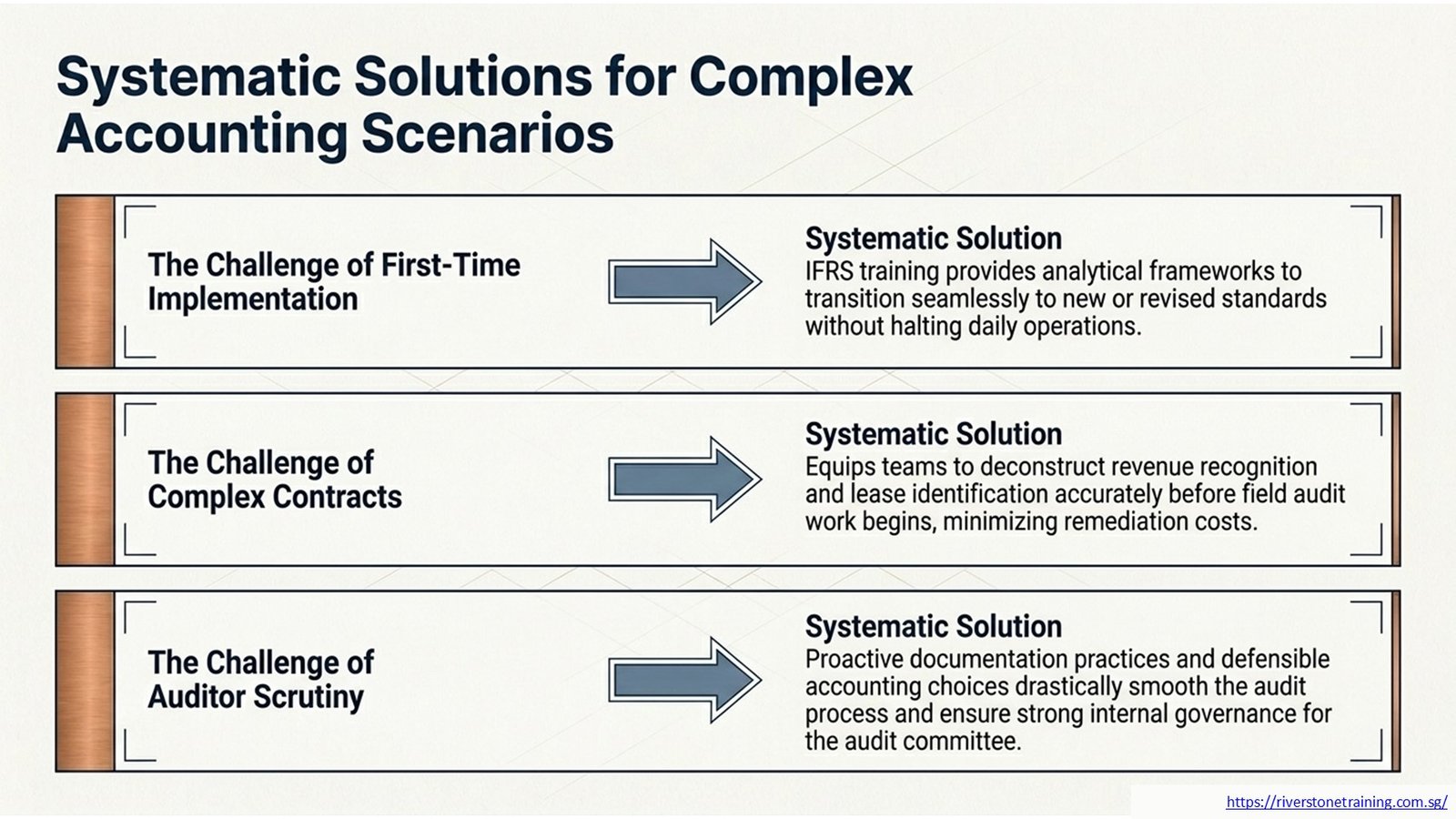
The typical problems in revenue recognition in complex contracts, lease identification and classification, financial instrument measurement, financial instrument impairment testing, and group consolidated financial statement preparation are common issues faced by finance professionals. There is technical knowledge of the applicable standard and judgment involved in using that standard in specific transactions in each of these areas. Training serves as a basis for solving these problems systematically and not reactively.
Seeking to prepare compliant disclosures in a timely manner, dealing with the first-time implementation of a new standard, and addressing auditor queries related to accounting judgments are among the other common challenges. Structured IFRS training empowers finance professionals to navigate these scenarios more confidently, as they have acquired technical expertise, documentation practices, and analytical frameworks to inform sound accounting choices.
How Can IFRS Improve Communication With Investors and Stakeholders?
Financial statements provide information that is relied upon by investors and stakeholders in making decisions regarding asset allocation, credit extension, and business relationships. Financial statements prepared in IFRS form give a common framework that investors are able to interpret the same way irrespective of the company’s home jurisdiction. Finance professionals who are able to make and clarify IFRS-compliant statements straighten the path to the organization’s credibility and transparency to the investment community.
Finance professionals can also have a pivotal role in communicating effectively with stakeholders by translating complex accounting results into easy-to-understand language. IFRS training builds not only technical skills, but the skills required to explain accounting policies used, the basis for making important estimates, and how reported numbers correlate with underlying business. The ability to communicate is becoming more important in financial jobs that come into direct contact with investors, analysts and the board.
What Skills Are Developed Through an IFRS Finance Course?
The IFRS finance course builds a full body of financial reporting skills which involve the preparation of credible primary statements, the compilation of accounting policy notes, the knowledge of the main IFRS standards and their recognition and measurement principles, and the documentation of accounting judgments for audit purposes. Participants build up technical expertise and professional judgment to apply IFRS in complex reporting scenarios.
In addition to technical skills, IFRS training builds analytical ability, which involves an ability to be critical in reviewing financial statements, find possible accounting misstatements, and evaluate the accounting treatment of business transactions and contractual relationships. The analytical skills acquired through IFRS training can immediately be used in various financial sectors, such as financial control, external audit, financial planning and analysis, and investor relations, making it a widely useful professional investment.
Table 4: IFRS Knowledge and Finance Career Development
| Role | IFRS Application | Career Benefit |
| Accountant | Financial statement preparation and compliance | Stronger technical reporting foundation |
| External Auditor | Compliance review and audit evidence evaluation | More effective audit execution |
| Finance Manager | Financial oversight and reporting governance | Improved management reporting quality |
| Financial Analyst | Statement analysis and performance interpretation | More reliable investment analysis |
| Financial Controller | Group reporting and accounting policy management | Stronger close and consolidation capability |
| Finance Director | Board reporting and governance oversight | Greater credibility with stakeholders |
How Does IFRS Knowledge Complement Digital Finance and Fintech Skills?
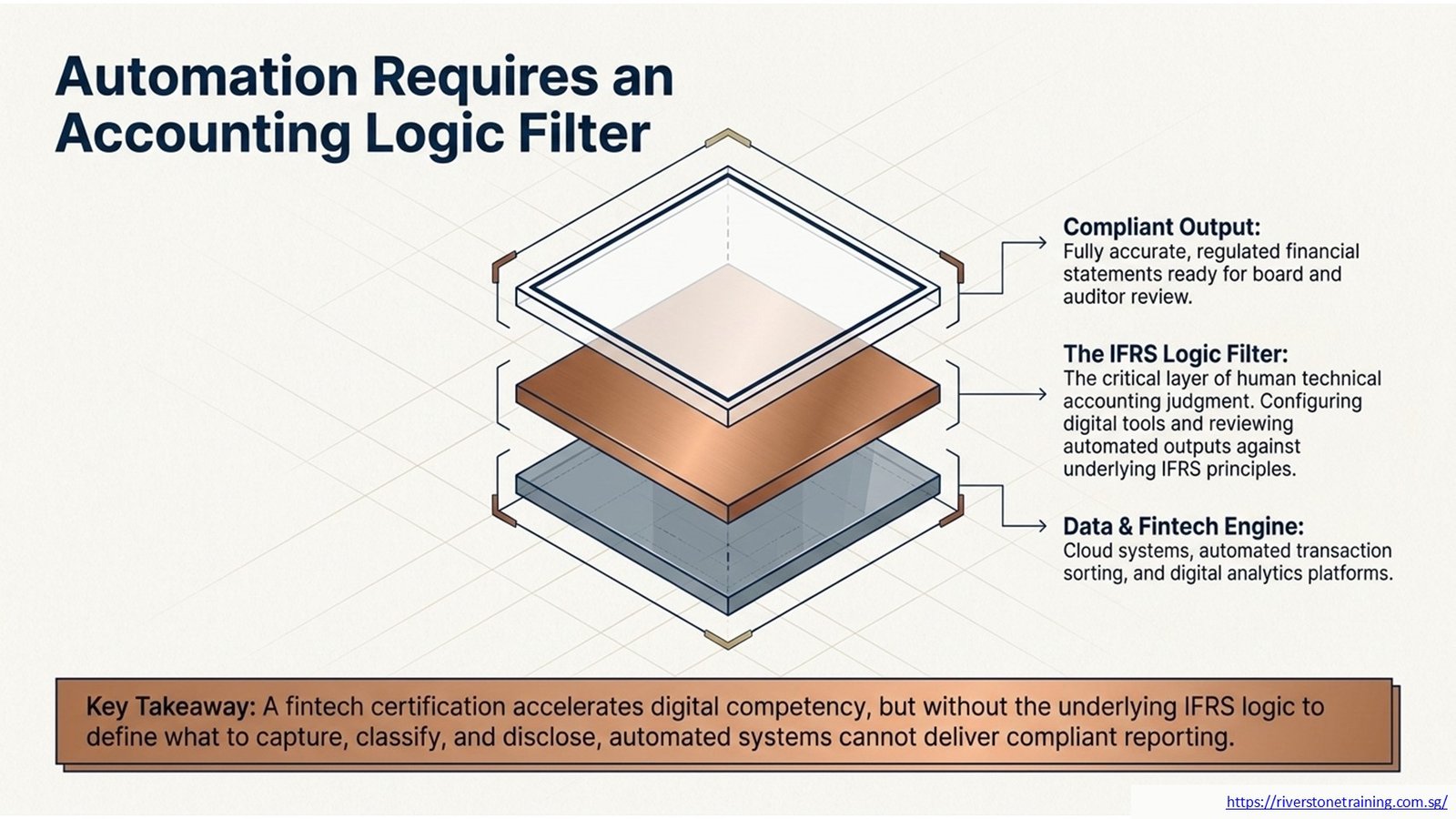
Today, the finance profession demands that financial professionals now possess both technical accounting expertise and digital finance skills as well. Even with the automation of reporting, data analytics platforms and cloud-based accounting systems, finance professionals with a grasp of IFRS principles behind the reports generated are still required. IFRS knowledge enables correct configuration of digital reporting tools and review of automated outputs using appropriate technical judgment. A fintech certification can offer a structured approach for finance professionals seeking to broaden their digital competencies, equipping them with the skills needed to navigate the evolving digital landscape of financial services.
The digital finance skills and IFRS knowledge are especially significant for professionals in the financial data management, regulatory technology, and automated reporting sectors. By grasping the principles behind IFRS standards on what to capture, classify, and disclose for financial information, finance professionals can collaborate better with technology implementations and ensure that digital systems deliver compliant reporting outputs.
How Can Financial Reporting Skills Support Career Development?
A key attribute that is consistently sought in a finance professional is the ability to make a strong presentation on financial matters. There is a need for accountants, controllers, auditors, as well as finance managers who can prepare and review high-quality IFRS-compliant financial statements in listed companies, financial institutions, multinational corporations, and professional services firms. Competency in IFRS is a technical credibility that helps to advance career paths in higher finance and governance positions.
Financial reporting skills also serve as a stepping-stone to other related fields such as financial planning and analysis, financial treasury, investor relations, and corporate finance. Business professionals who grasp the accounting basis of business performance have a significant edge in moving into a position where their job demands that they interpret, communicate, or act on financial information; therefore, IFRS learning is a good career investment.
How Does Continuous Learning Help Finance Professionals Stay Relevant?
The financial reporting landscape is ever-changing. New and revised IFRS standards are published on a frequent basis, regulators’ reporting requirements change from time to time, and industry practice evolves to reflect new transactions and business models. Continuous learning finance professionals keep abreast of these developments and ensure they are technically up to date and can apply standards properly as they progress.
Continuous professional development also demonstrates professional credibility and professional commitment to quality – something that is important to employers, regulators and audit committees. Structured learning programs, such as IFRS training and other additional qualifications, create a continuous body of skills and expertise which can lead to career relevance. Reporting has become a growing challenge and a growing expectation in an increasingly complex world, and continuous learning is not optional; it is a must for every professional.
Conclusion
An IFRS finance course provides tangible benefits in terms of better financial reporting quality by giving the professionals the technical knowledge, practical judgment and disclosure skills to apply international accounting standards properly. IFRS training builds competency in all areas of reporting difficulties faced by finance professionals in practice, including revenue recognition, fair value measurement, lease accounting and financial instrument classification.
IFRS expertise enhances accurate financial reporting, fuller disclosures, an easier audit process, and increased trust from users of the financial statements. It also serves as a stepping stone to further career advancement through the broader field of career development, allowing finance professionals to move up to senior reporting, governance and analytical positions, where IFRS competency is one of the core requirements.
An IFRS finance course is an investment in the technical skills that are the foundation of credible, compliant, and high-quality financial reporting that can help professionals build or enhance their financial reporting skills. In a world of rapidly changing reporting requirements, CPCs who are well-versed in IFRS and have expanded their continuing education with a fintech certification for digital finance competency will be best suited to stay relevant, capable, and impactful in an ever-evolving finance landscape.
Table 5: IFRS Finance Course — Summary of Key Learning Outcomes
| Learning Area | Skill Developed | Career / Organizational Benefit |
| Financial Statement Preparation | Accurate recognition and measurement | Compliant and reliable reporting |
| Disclosure Management | Complete and clear note preparation | Stronger audit and regulatory outcomes |
| Fair Value Measurement | Asset and liability valuation | Accurate balance sheet reporting |
| Revenue Recognition | IFRS 15 contract analysis | Reliable income statement outcomes |
| Financial Analysis | Interpreting IFRS-based data | Better-informed business decisions |
| Compliance and Governance | Applying standards consistently | Reduced reporting risk and audit findings |