How Can Finance Workshops Help Managers Make Better Business Decisions?

Managerial financial skills allow managers to interpret financial statements, create financial budgets, predict company performance and analyze financial results with increased assurance. Managers learn to make better business decisions, allocate resources well, and make data-based recommendations rather than data-less recommendations through practical finance workshops.

Why Do Managers Need Financial Knowledge?

Financial knowledge is essential for managers because all their operational decisions have a cost, a return, or a risk, which only financial capability can identify precisely. Without this, a marketing lead could approve a campaign that dips into margin, or a project manager could approve a timeline that assumes that cash flow isn’t a problem. By having financial skills and understanding, managers can communicate with finance teams and executives in the same language, and make decisions based on numbers, not just gut feel.

This need has increased due to the delegation of decision-making power to department heads and team leaders. A manager can act faster and with more confidence than a manager who has to wait for finance to interpret the numbers on a profit and loss statement or variance report. This is the confidence and speed which structured learning provides, and it is what a finance workshop for managers is supposed to provide. 

What Is a Finance Workshop for Managers?

A finance workshop for managers is a formal training session designed to impart the skills of reading financial statements, building budgets, forecasting financial outcomes, and using financial thinking in everyday business decisions to non-finance managers. It is not an academic finance class, but rather a more hands-on class, centered on real business situations, like pricing decisions, hiring plans, and capital requests. Each session is a mixture of short talks and practical activities — such as creating a basic budget or exploring a case study. 

The goal is to build confidence, not to turn managers into accountants. For managers based in Singapore, resources such as this overview of finance workshop for managers outline exactly which financial tools and training modules deliver the most value at each stage of a manager’s career. This applied approach is why organizations increasingly treat financial training as a core leadership competency rather than an optional extra.

Essential Finance Skills for Managers

Skill Business Benefit
Financial Statement Analysis Better decision-making
Budgeting Resource planning
Forecasting Future business planning
Cost Analysis Improved profitability
Performance Measurement Clearer accountability

How Do Managers Read Financial Statements?
Managerial Financial Skills

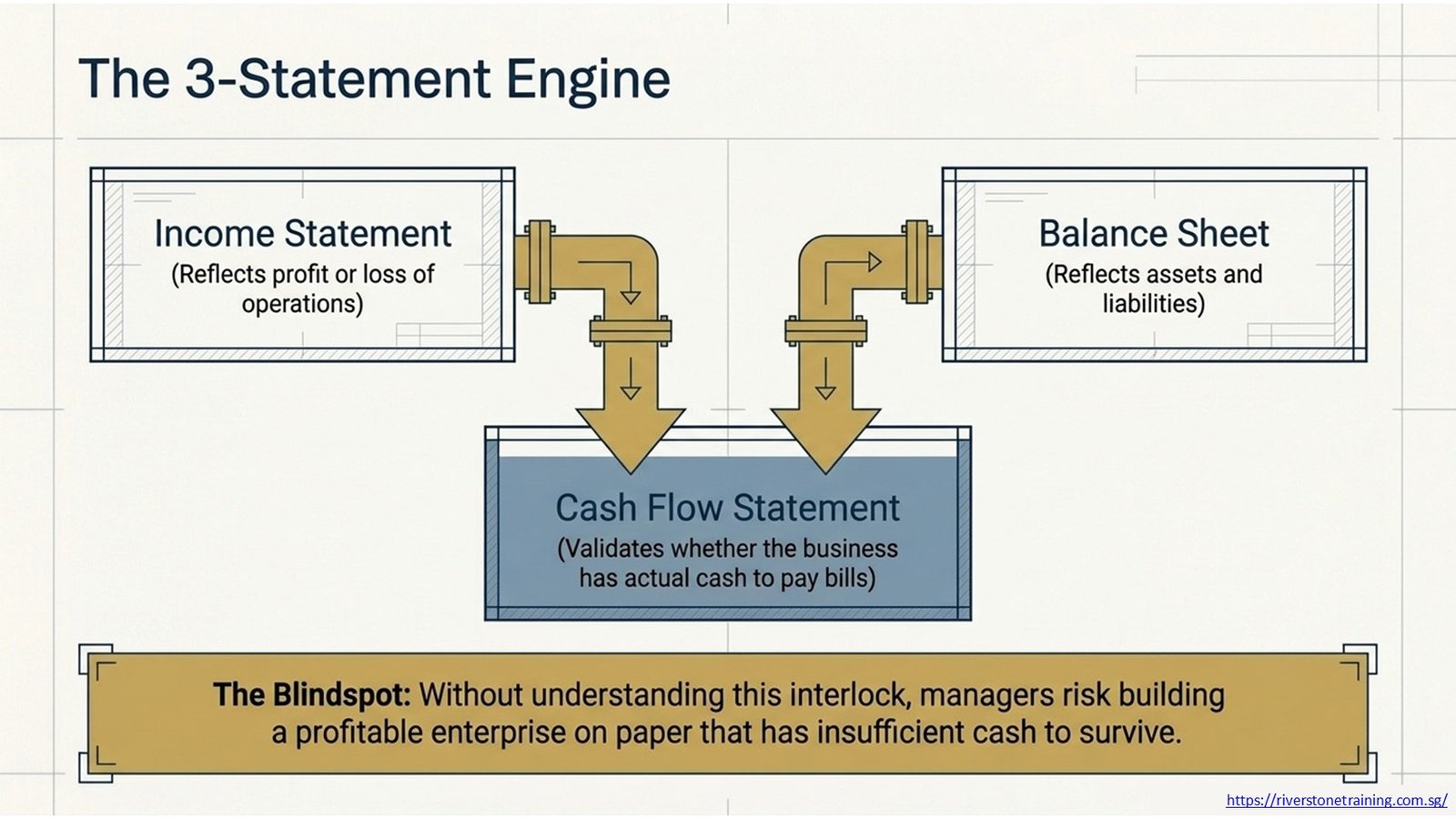
Financial statements are read by managers starting with three basic financial statements: the income statement, the balance sheet and the cash flow statement, each of which answers a different question about the business. The income statement reflects profit or loss of the operations; the balance sheet reflects the assets and liabilities of the business; and the cash flow statement reflects whether the business has enough cash to pay its bills. A business manager with knowledge about the interaction of these three can anticipate issues—like a profitable enterprise with insufficient cash—before they get out of hand.

This skill is taught in workshops by having students review some actual or simulated statements instead of by lecturing. Managers learn how to trace back from an income statement increase to the line item, or simply to find out if rising receivables are quietly bleeding cash. This practical statement analysis helps managers become used to verifying numbers before making a decision. 

How Does Budgeting Improve Business Decisions?
Managerial Financial Skills

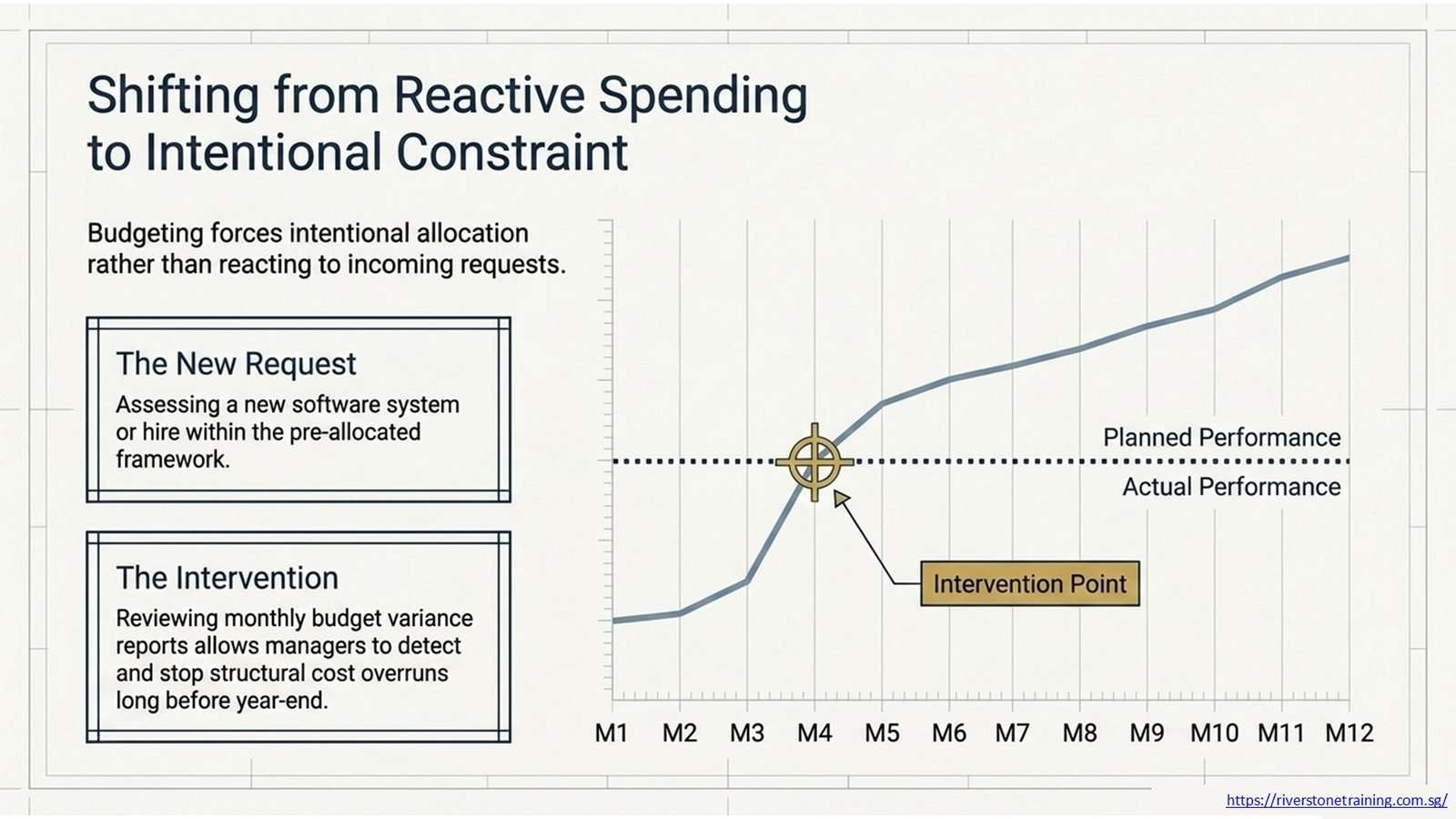
Budgeting helps to make better business decisions because managers are required to allocate resources intentionally rather than respond to requests as they come in. By approving a new employee or software system on top of a pre-allocated annual budget, a department head can assess the new product within the framework of the existing department budget. This field minimises the chances of overspending one month and having to trim back the following month.

Another advantage of budgeting is that it provides accountability, as the actual performance can be reviewed against the planned performance to see the differences. A monthly budget variance report can be reviewed by a manager, and they’ll be able to stop a cost overrun getting to the end of the year. Workshops usually involve a practical budgeting activity, enabling managers to take a template away with them that they can use right away. 

Why Is Forecasting Important for Managers?

Forecasting is important for managers because it changes planning from looking backwards to looking forwards and what is likely to happen next. A sales manager who is able to predict what he will sell in the upcoming quarter, in advance of when the orders arrive, can plan staffing and inventory levels in advance of other orders, as opposed to reacting to the orders. This forward-thinking approach is particularly beneficial in companies that are subject to seasonal or project-driven income.

Also, because good forecasting comes with good conversation, with senior leaders, a manager who can articulate the assumptions that went into his or her forecast is much more credible than one who just sends a single number. Workshops develop managers’ ability to prepare rolling forecasts which are revised as they receive new information, not static annual forecasts which quickly become outdated. 

Budgeting vs. Forecasting

Budgeting Forecasting
Sets financial targets Updates expected performance
Annual planning Ongoing adjustments
Resource allocation Future projections
Performance control Business planning

How Does Financial Analysis Support Strategic Planning?

Financial analysis is used to test the financial viability of a proposed strategy prior to investing resources in it and is used in conjunction with strategic planning. Financial analysis can be used to develop a model to represent the investment involved, the returns that can be expected, and the break-even point, and thus transform a business idea into a testable business case for a manager considering a market expansion. This helps avoid strategy being based solely on what other people are doing. 

Structured training, such as a financial analysis certification course, strengthens this capability by teaching managers to interpret ratios, trends, and comparative data with the same rigor a finance team would apply. This deeper analytical grounding shows up directly in stronger strategic proposals and more defensible business cases.

How Can Managers Evaluate Business Performance?

Managers report on business performance by comparing actual results to a set of predetermined financial and operational metrics, not based on general impressions. A team leader may measure margin, cost per unit and productivity all in one, as this can be a misleading measurement alone. When combined, this overview can better distinguish between actual performance issues versus short-term performance fluctuations.

Best practice with performance evaluation is to keep it regular and consistent, rather than being a one-off at the end of the year. Workshops help managers establish a habit of reviewing their performance monthly – comparing a few salient measurements to goals – so that problems are detected at a time when they can be easily fixed. 

What Financial KPIs Should Managers Monitor?
Managerial Financial Skills

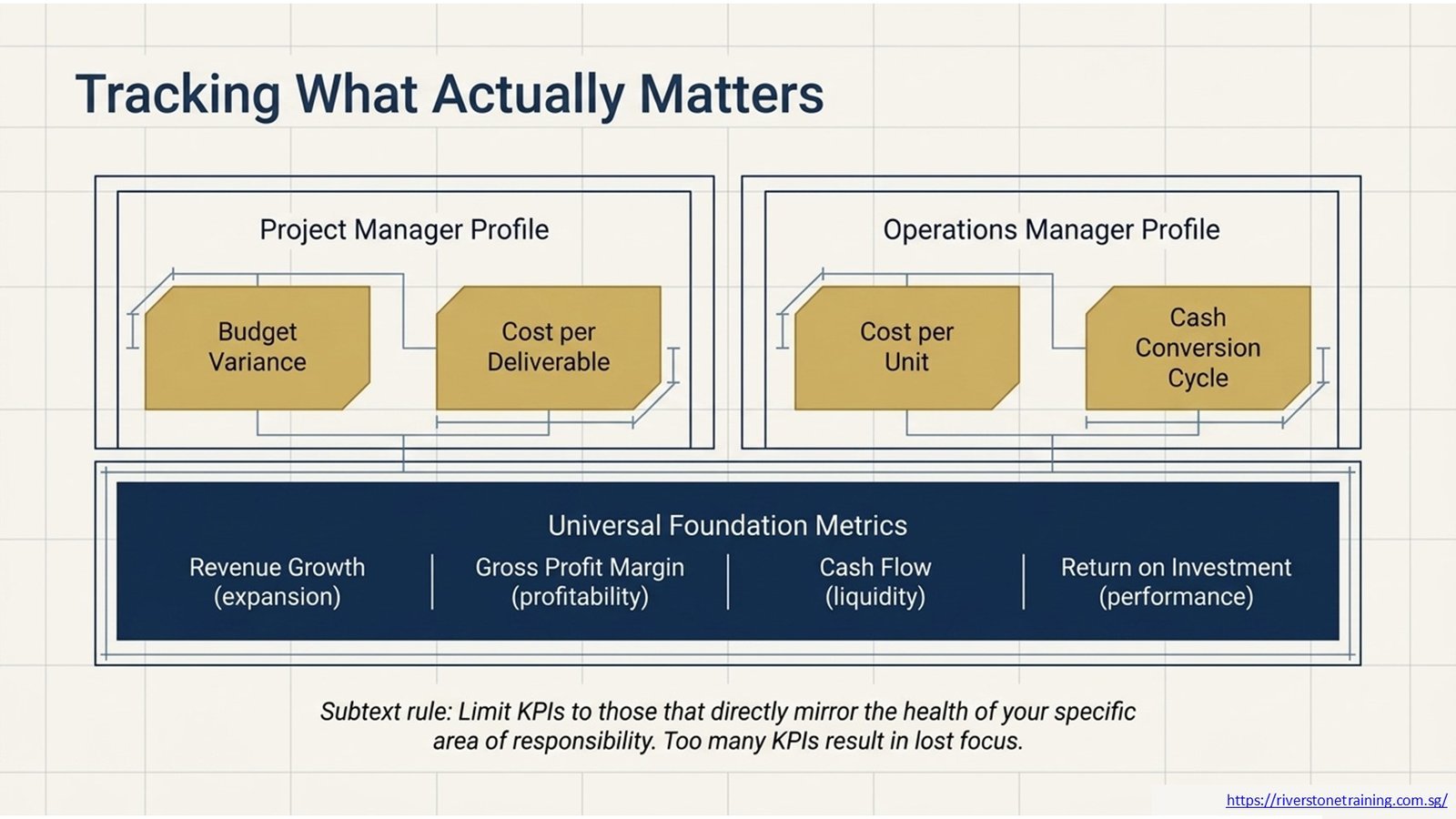
Managers should not keep too many financial KPIs and should only keep those that most directly mirror the health of their area of responsibility. To get started, consider first revenue growth, gross margin, cash flow, and return on investment, which all relate directly to profitability and liquidity. The more KPIs you have, the more you tend to lose focus.

The right KPIs depend on the job. Budget variance and cost per deliverable might be a project manager’s priority, whereas cost per unit and cash conversion cycle might be a priority of an operations manager. Through Finance workshops, managers are assisted in choosing and monitoring relevant KPIs to their respective roles. 

Financial KPIs Managers Should Track

KPI Why It Matters
Revenue Growth Measures business expansion
Gross Profit Margin Assesses profitability
Cash Flow Monitors liquidity
Return on Investment Evaluates business performance
Budget Variance Tracks spending discipline

How Does Cost Analysis Improve Resource Allocation?

Cost analysis helps to allocate resources because it gives the manager a clear picture of where the money is going and if he is getting a proportional return from the money. A manager who knows as much about breaking costs down by product line, project, or department can see what areas are worth investing more in and what areas are sucking up budget without an otherwise noticeable way to keep them up. If it is not visible, it is not used.

Workshops cover cost analysis skills, including fixed and variable costs, and work out how to work out the reasons why a budget has gone over. A manager who can identify an isolated cost increase as a structural cost issue is in a better position to make a decision about reducing the cost, redirecting resources, or investing in further cost reduction.

Management Decisions Supported by Financial Analysis

Business Decision Financial Analysis Used
Pricing Strategy Cost analysis
Investment Decisions ROI analysis
Expansion Planning Cash flow forecasting
Expense Management Budget variance analysis
Hiring Decisions Capital and cost-benefit analysis

How Can Finance Workshops Improve Cross-Department Collaboration?
Managerial Financial Skills

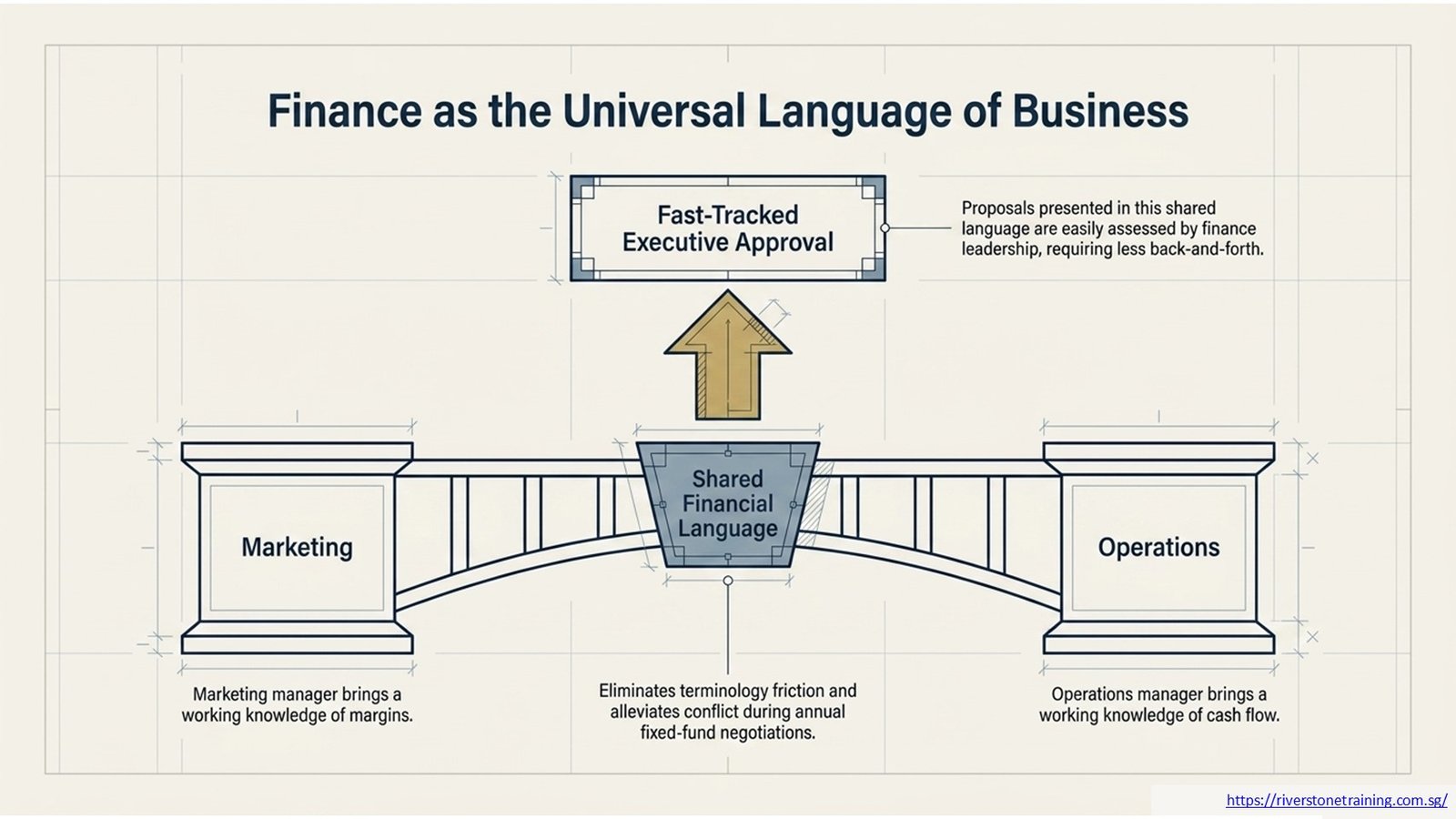
Finance workshops provide real cross-department collaboration, as managers in various departments get a common financial language and are no longer held back by mere financial terminology in discussions related to budgets and priorities. When looking to the negotiation of shared resources, a marketing manager with a working knowledge of margin and an operations manager with a working knowledge of cash flow can communicate more effectively than either one side or the other.

This common language also helps alleviate conflict when planning happens on an annual basis, when departments have to vie for a fixed amount of funds. Managers who receive the same finance training present requests in a way that finance leadership can easily assess quickly, making it quicker to approve and less back and forth. 

How Does Financial Analysis Certification Strengthen Professional Skills?

A financial analysis certification course enhances the professional competence of a manager by demonstrating the level of financial analysis beyond the level of basic competence – this course introduces and expands on the concepts of ratio analysis, trend analysis and valuation concepts beyond the scope of a short workshop. This additional knowledge is especially useful for managers who are transitioning to a senior or cross-functional position where they need to make financial decisions every day.

It also indicates credibility to peers and leadership as it demonstrates that a manager has been tested and exposed to the application of financial concepts, rather than simply exposed to them. Many managers have initially offered finance training for managers, and then follow the training with a finance certification course, which they have used to gain confidence at the start and then move on to deeper financial training. 

What Common Financial Mistakes Should Managers Avoid?

Some common pitfalls managers can avoid are approving spend without verifying the impact to the budget, and acting on a single data point without verifying other supporting data. Even if the department appears to be profitable on paper, it can still have problems with customers who pay slowly or because of too much inventory.

One common error is that a budget is not checked against performance, but considered as a fixed sum. Workshops directly confront these patterns by trawling through real examples of decisions which seemed well made at the time, but failed to consider an important financial pattern, to help managers develop better instincts for the future. 

How Can Finance Training Improve Leadership Effectiveness?

Finance training strengthens leadership effectiveness as it enables managers to make and justify decisions with data and not leave all financial decision-making to the finance function. A leader who can assist in understanding the monetary justification for a hiring plan or a project cut is more trusted by both the employees and the top leaders.

This confidence also translates to better communication from leaders upwards because executives are more likely to accept proposals that are about cost, return and risk. Financially literate leaders will have fewer minor decisions to escalate because they can make more of them on their own and rightfully. 

How Do Finance Skills Support Long-Term Business Growth?

Finance skills can help the business grow in the long term as managers make consistent, good decisions on the use of resources in numerous small decisions, not just a few big ones. Growth rarely happens from one great decision; it happens as a result of consistent and disciplined budgeting, thoughtful investment evaluation and steady cost management over a number of years.

Organizations that have financially knowledgeable managers all the way to the top benefit in two ways during times of downturn and growth: they know the value of financial discipline in decision-making at all levels of the organization, not just in a small finance team, and they scale more efficiently when times are good or scale back more effectively when times are tough. 

Why Should Managers Continue Developing Financial Skills?

Managers should keep building their financial skills as business conditions, reporting requirements, and analysis tools are changing, and a workshop is a beginning, not an endpoint. A Manager who repeats financial training from time to time remains updated with all the new KPIs, forecasting models and analytical methods required by the industry.

There’s also the fact that further development also accumulates over the course of a career: those who complete the base-level finance workshops and then move on to more advanced levels are likely to be offered more leadership opportunities. Financial education is a continuous process and not a one-off requirement, and it is one of the safer investments that a manager can make in himself. 

Summary: How Finance Training Builds Managerial Decision-Making

Training Focus Managerial Outcome
Financial Statement Reading Faster, more accurate operational decisions
Budgeting & Forecasting Disciplined planning and resource control
KPI & Performance Tracking Earlier detection of performance issues
Financial Analysis Certification Stronger strategic and investment judgment
Ongoing Financial Education Sustained leadership growth over time

Conclusion of Managerial Financial Skills

Through finance workshops, managers will develop practical skills and understand how to analyse financial statements, budgets, forecasts, and assess performance against clear KPIs, enabling them to make better business decisions. The features enable managers to shift from reactive decision-making to evidence-based planning, for allocating a department budget, evaluating an investment, or defending a strategic proposal to senior management.

A good finance workshop for managers is built upon this foundation efficiently and turns the basic concepts into tools that managers can use the same week. A financial analysis certification course provides additional expertise in ratio analysis, trend analysis, and valuation, further building the analytical skills that are critical for long-term managerial decisions and investments.

Financial literacy isn’t something that is completed but is a duty for all who lead people, budgets, or projects. Financial education is not a one-off course, but an ongoing part of a manager’s professional development. Financial education is not a one-time training, but a continuous process in the development of managers. 
Frequently Asked Questions

What is a finance workshop for managers?

A finance workshop for managers is a brief, hands-on training session for a non-finance employee to learn how to read financial statements, create budgets, and use financial reasoning when making business decisions. It is based on practice exercises and not theory, and builds managers’ confidence in understanding numbers and supporting their decisions by presenting financial evidence in everyday operational situations. 

Financial analysis skills for managers are essential since the vast majority of all operational decisions, including pricing and hiring, are financial and can only be demonstrated through sound financial analysis. If these skills are not in place, managers will make decisions based on intuition or on information that is only fed to them after it is too late. The financial analysis enables managers to make decisions with evidence and on their own.

Business finance workshops develop business decisions by educating managers on reading business finance reports, creating budgets, and analyzing KPIs before putting resources to use. This formalized process replaces the guesswork with facts, which allows managers to better allocate budgets, detect performance problems sooner, and bring in proposals that are more likely to be accepted by finance teams and senior management. 

Financial analysis training usually includes skills in interpreting income statements, balance sheets, cash flow statements, ratio analysis, forecasting, budgeting, cost analysis, and tracking key performance indicators (KPIs). Other financial analysis certification courses are more advanced, including concepts from valuation and trend analysis, to provide managers with more sophisticated tools for strategic and investment decisions. 

Finance skills aid in leadership positions by enabling decision-making and defense without supervision, better communication with senior management, and problem-solving before it becomes a problem. Financial statements and KPIs are essential to earning trust from executives and employees, as they make decisions based on facts, not assumptions.

Managers can attend a finance workshop with no prior finance experience. They are suitable for professionals with no financial expertise, covering key concepts such as financial statements through to budgeting, forecasting and KPI analysis, and are accessible to managers across all departments and experience levels.

Managerial financial skills allow managers to interpret financial statements, create financial budgets, predict company performance and analyze financial results with increased assurance. Managers learn to make better business decisions, allocate resources well, and make data-based recommendations rather than data-less recommendations through practical finance workshops.

Why Do Managers Need Financial Knowledge?

Financial knowledge is essential for managers because all their operational decisions have a cost, a return, or a risk, which only financial capability can identify precisely. Without this, a marketing lead could approve a campaign that dips into margin, or a project manager could approve a timeline that assumes that cash flow isn’t a problem. By having financial skills and understanding, managers can communicate with finance teams and executives in the same language, and make decisions based on numbers, not just gut feel.

This need has increased due to the delegation of decision-making power to department heads and team leaders. A manager can act faster and with more confidence than a manager who has to wait for finance to interpret the numbers on a profit and loss statement or variance report. This is the confidence and speed which structured learning provides, and it is what a finance workshop for managers is supposed to provide. 

What Is a Finance Workshop for Managers?

A finance workshop for managers is a formal training session designed to impart the skills of reading financial statements, building budgets, forecasting financial outcomes, and using financial thinking in everyday business decisions to non-finance managers. It is not an academic finance class, but rather a more hands-on class, centered on real business situations, like pricing decisions, hiring plans, and capital requests. Each session is a mixture of short talks and practical activities — such as creating a basic budget or exploring a case study. 

The goal is to build confidence, not to turn managers into accountants. For managers based in Singapore, resources such as this overview of finance workshop for managers outline exactly which financial tools and training modules deliver the most value at each stage of a manager’s career. This applied approach is why organizations increasingly treat financial training as a core leadership competency rather than an optional extra.

Essential Finance Skills for Managers

Skill Business Benefit
Financial Statement Analysis Better decision-making
Budgeting Resource planning
Forecasting Future business planning
Cost Analysis Improved profitability
Performance Measurement Clearer accountability

How Do Managers Read Financial Statements?

Managerial Financial Skills

Financial statements are read by managers starting with three basic financial statements: the income statement, the balance sheet and the cash flow statement, each of which answers a different question about the business. The income statement reflects profit or loss of the operations; the balance sheet reflects the assets and liabilities of the business; and the cash flow statement reflects whether the business has enough cash to pay its bills. A business manager with knowledge about the interaction of these three can anticipate issues—like a profitable enterprise with insufficient cash—before they get out of hand.

This skill is taught in workshops by having students review some actual or simulated statements instead of by lecturing. Managers learn how to trace back from an income statement increase to the line item, or simply to find out if rising receivables are quietly bleeding cash. This practical statement analysis helps managers become used to verifying numbers before making a decision. 

How Does Budgeting Improve Business Decisions?

Managerial Financial Skills

Budgeting helps to make better business decisions because managers are required to allocate resources intentionally rather than respond to requests as they come in. By approving a new employee or software system on top of a pre-allocated annual budget, a department head can assess the new product within the framework of the existing department budget. This field minimises the chances of overspending one month and having to trim back the following month.

Another advantage of budgeting is that it provides accountability, as the actual performance can be reviewed against the planned performance to see the differences. A monthly budget variance report can be reviewed by a manager, and they’ll be able to stop a cost overrun getting to the end of the year. Workshops usually involve a practical budgeting activity, enabling managers to take a template away with them that they can use right away. 

Why Is Forecasting Important for Managers?

Forecasting is important for managers because it changes planning from looking backwards to looking forwards and what is likely to happen next. A sales manager who is able to predict what he will sell in the upcoming quarter, in advance of when the orders arrive, can plan staffing and inventory levels in advance of other orders, as opposed to reacting to the orders. This forward-thinking approach is particularly beneficial in companies that are subject to seasonal or project-driven income.

Also, because good forecasting comes with good conversation, with senior leaders, a manager who can articulate the assumptions that went into his or her forecast is much more credible than one who just sends a single number. Workshops develop managers’ ability to prepare rolling forecasts which are revised as they receive new information, not static annual forecasts which quickly become outdated. 

Budgeting vs. Forecasting

Budgeting Forecasting
Sets financial targets Updates expected performance
Annual planning Ongoing adjustments
Resource allocation Future projections
Performance control Business planning

How Does Financial Analysis Support Strategic Planning?

Financial analysis is used to test the financial viability of a proposed strategy prior to investing resources in it and is used in conjunction with strategic planning. Financial analysis can be used to develop a model to represent the investment involved, the returns that can be expected, and the break-even point, and thus transform a business idea into a testable business case for a manager considering a market expansion. This helps avoid strategy being based solely on what other people are doing. 

Structured training, such as a financial analysis certification course, strengthens this capability by teaching managers to interpret ratios, trends, and comparative data with the same rigor a finance team would apply. This deeper analytical grounding shows up directly in stronger strategic proposals and more defensible business cases.

How Can Managers Evaluate Business Performance?

Managers report on business performance by comparing actual results to a set of predetermined financial and operational metrics, not based on general impressions. A team leader may measure margin, cost per unit and productivity all in one, as this can be a misleading measurement alone. When combined, this overview can better distinguish between actual performance issues versus short-term performance fluctuations.

Best practice with performance evaluation is to keep it regular and consistent, rather than being a one-off at the end of the year. Workshops help managers establish a habit of reviewing their performance monthly – comparing a few salient measurements to goals – so that problems are detected at a time when they can be easily fixed. 

What Financial KPIs Should Managers Monitor?

Managerial Financial Skills

Managers should not keep too many financial KPIs and should only keep those that most directly mirror the health of their area of responsibility. To get started, consider first revenue growth, gross margin, cash flow, and return on investment, which all relate directly to profitability and liquidity. The more KPIs you have, the more you tend to lose focus.

The right KPIs depend on the job. Budget variance and cost per deliverable might be a project manager’s priority, whereas cost per unit and cash conversion cycle might be a priority of an operations manager. Through Finance workshops, managers are assisted in choosing and monitoring relevant KPIs to their respective roles. 

Financial KPIs Managers Should Track

KPI Why It Matters
Revenue Growth Measures business expansion
Gross Profit Margin Assesses profitability
Cash Flow Monitors liquidity
Return on Investment Evaluates business performance
Budget Variance Tracks spending discipline

How Does Cost Analysis Improve Resource Allocation?

Cost analysis helps to allocate resources because it gives the manager a clear picture of where the money is going and if he is getting a proportional return from the money. A manager who knows as much about breaking costs down by product line, project, or department can see what areas are worth investing more in and what areas are sucking up budget without an otherwise noticeable way to keep them up. If it is not visible, it is not used.

Workshops cover cost analysis skills, including fixed and variable costs, and work out how to work out the reasons why a budget has gone over. A manager who can identify an isolated cost increase as a structural cost issue is in a better position to make a decision about reducing the cost, redirecting resources, or investing in further cost reduction.

Management Decisions Supported by Financial Analysis

Business Decision Financial Analysis Used
Pricing Strategy Cost analysis
Investment Decisions ROI analysis
Expansion Planning Cash flow forecasting
Expense Management Budget variance analysis
Hiring Decisions Capital and cost-benefit analysis

How Can Finance Workshops Improve Cross-Department Collaboration?

Managerial Financial Skills

Finance workshops provide real cross-department collaboration, as managers in various departments get a common financial language and are no longer held back by mere financial terminology in discussions related to budgets and priorities. When looking to the negotiation of shared resources, a marketing manager with a working knowledge of margin and an operations manager with a working knowledge of cash flow can communicate more effectively than either one side or the other.

This common language also helps alleviate conflict when planning happens on an annual basis, when departments have to vie for a fixed amount of funds. Managers who receive the same finance training present requests in a way that finance leadership can easily assess quickly, making it quicker to approve and less back and forth. 

How Does Financial Analysis Certification Strengthen Professional Skills?

A financial analysis certification course enhances the professional competence of a manager by demonstrating the level of financial analysis beyond the level of basic competence – this course introduces and expands on the concepts of ratio analysis, trend analysis and valuation concepts beyond the scope of a short workshop. This additional knowledge is especially useful for managers who are transitioning to a senior or cross-functional position where they need to make financial decisions every day.

It also indicates credibility to peers and leadership as it demonstrates that a manager has been tested and exposed to the application of financial concepts, rather than simply exposed to them. Many managers have initially offered finance training for managers, and then follow the training with a finance certification course, which they have used to gain confidence at the start and then move on to deeper financial training. 

What Common Financial Mistakes Should Managers Avoid?

Some common pitfalls managers can avoid are approving spend without verifying the impact to the budget, and acting on a single data point without verifying other supporting data. Even if the department appears to be profitable on paper, it can still have problems with customers who pay slowly or because of too much inventory.

One common error is that a budget is not checked against performance, but considered as a fixed sum. Workshops directly confront these patterns by trawling through real examples of decisions which seemed well made at the time, but failed to consider an important financial pattern, to help managers develop better instincts for the future. 

How Can Finance Training Improve Leadership Effectiveness?

Finance training strengthens leadership effectiveness as it enables managers to make and justify decisions with data and not leave all financial decision-making to the finance function. A leader who can assist in understanding the monetary justification for a hiring plan or a project cut is more trusted by both the employees and the top leaders.

This confidence also translates to better communication from leaders upwards because executives are more likely to accept proposals that are about cost, return and risk. Financially literate leaders will have fewer minor decisions to escalate because they can make more of them on their own and rightfully. 

How Do Finance Skills Support Long-Term Business Growth?

Finance skills can help the business grow in the long term as managers make consistent, good decisions on the use of resources in numerous small decisions, not just a few big ones. Growth rarely happens from one great decision; it happens as a result of consistent and disciplined budgeting, thoughtful investment evaluation and steady cost management over a number of years.

Organizations that have financially knowledgeable managers all the way to the top benefit in two ways during times of downturn and growth: they know the value of financial discipline in decision-making at all levels of the organization, not just in a small finance team, and they scale more efficiently when times are good or scale back more effectively when times are tough. 

Why Should Managers Continue Developing Financial Skills?

Managers should keep building their financial skills as business conditions, reporting requirements, and analysis tools are changing, and a workshop is a beginning, not an endpoint. A Manager who repeats financial training from time to time remains updated with all the new KPIs, forecasting models and analytical methods required by the industry.

There’s also the fact that further development also accumulates over the course of a career: those who complete the base-level finance workshops and then move on to more advanced levels are likely to be offered more leadership opportunities. Financial education is a continuous process and not a one-off requirement, and it is one of the safer investments that a manager can make in himself. 

Summary: How Finance Training Builds Managerial Decision-Making

Training Focus Managerial Outcome
Financial Statement Reading Faster, more accurate operational decisions
Budgeting & Forecasting Disciplined planning and resource control
KPI & Performance Tracking Earlier detection of performance issues
Financial Analysis Certification Stronger strategic and investment judgment
Ongoing Financial Education Sustained leadership growth over time

Conclusion of Managerial Financial Skills

Through finance workshops, managers will develop practical skills and understand how to analyse financial statements, budgets, forecasts, and assess performance against clear KPIs, enabling them to make better business decisions. The features enable managers to shift from reactive decision-making to evidence-based planning, for allocating a department budget, evaluating an investment, or defending a strategic proposal to senior management.

A good finance workshop for managers is built upon this foundation efficiently and turns the basic concepts into tools that managers can use the same week. A financial analysis certification course provides additional expertise in ratio analysis, trend analysis, and valuation, further building the analytical skills that are critical for long-term managerial decisions and investments.

Financial literacy isn’t something that is completed but is a duty for all who lead people, budgets, or projects. Financial education is not a one-off course, but an ongoing part of a manager’s professional development. Financial education is not a one-time training, but a continuous process in the development of managers. 
Frequently Asked Questions

What is a finance workshop for managers?

A finance workshop for managers is a brief, hands-on training session for a non-finance employee to learn how to read financial statements, create budgets, and use financial reasoning when making business decisions. It is based on practice exercises and not theory, and builds managers’ confidence in understanding numbers and supporting their decisions by presenting financial evidence in everyday operational situations. 

Financial analysis skills for managers are essential since the vast majority of all operational decisions, including pricing and hiring, are financial and can only be demonstrated through sound financial analysis. If these skills are not in place, managers will make decisions based on intuition or on information that is only fed to them after it is too late. The financial analysis enables managers to make decisions with evidence and on their own.

Business finance workshops develop business decisions by educating managers on reading business finance reports, creating budgets, and analyzing KPIs before putting resources to use. This formalized process replaces the guesswork with facts, which allows managers to better allocate budgets, detect performance problems sooner, and bring in proposals that are more likely to be accepted by finance teams and senior management. 

Financial analysis training usually includes skills in interpreting income statements, balance sheets, cash flow statements, ratio analysis, forecasting, budgeting, cost analysis, and tracking key performance indicators (KPIs). Other financial analysis certification courses are more advanced, including concepts from valuation and trend analysis, to provide managers with more sophisticated tools for strategic and investment decisions. 

Finance skills aid in leadership positions by enabling decision-making and defense without supervision, better communication with senior management, and problem-solving before it becomes a problem. Financial statements and KPIs are essential to earning trust from executives and employees, as they make decisions based on facts, not assumptions.

Managers can attend a finance workshop with no prior finance experience. They are suitable for professionals with no financial expertise, covering key concepts such as financial statements through to budgeting, forecasting and KPI analysis, and are accessible to managers across all departments and experience levels.

Related Posts

Everything You Need to Know About Finance Courses

Advance your career with Riverstone’s expert-led finance courses. Get in touch with us now.