How Can AI Courses Prepare Finance Professionals for the Future?

By incorporating AI in accounting and finance courses, finance professionals can equip themselves with the skills necessary to thrive in the future, where AI will increasingly influence the role.An AI in accounting and finance course empowers finance professionals with the tools to excel in the future, where the role is increasingly shaped by AI. This training enables professionals to operate more efficiently with emerging technologies and not be replaced by these technologies. 

What Is an AI in Accounting and Finance Course?

An ai in accounting and finance course is structured training that teaches finance and accounting professionals how to apply artificial intelligence tools to real workplace tasks, including reporting, forecasting, and analysis. It brings together essential finance concepts and real-world experience with AI-driven software tools and processes.

These courses don’t focus solely on AI as a technical discipline but instead embed it into current finance operations. For instance, a learner could create a first draft of a variance analysis using an AI tool and then interpret and refine the analysis using professional judgment. 

Why Is AI Transforming the Finance Profession?

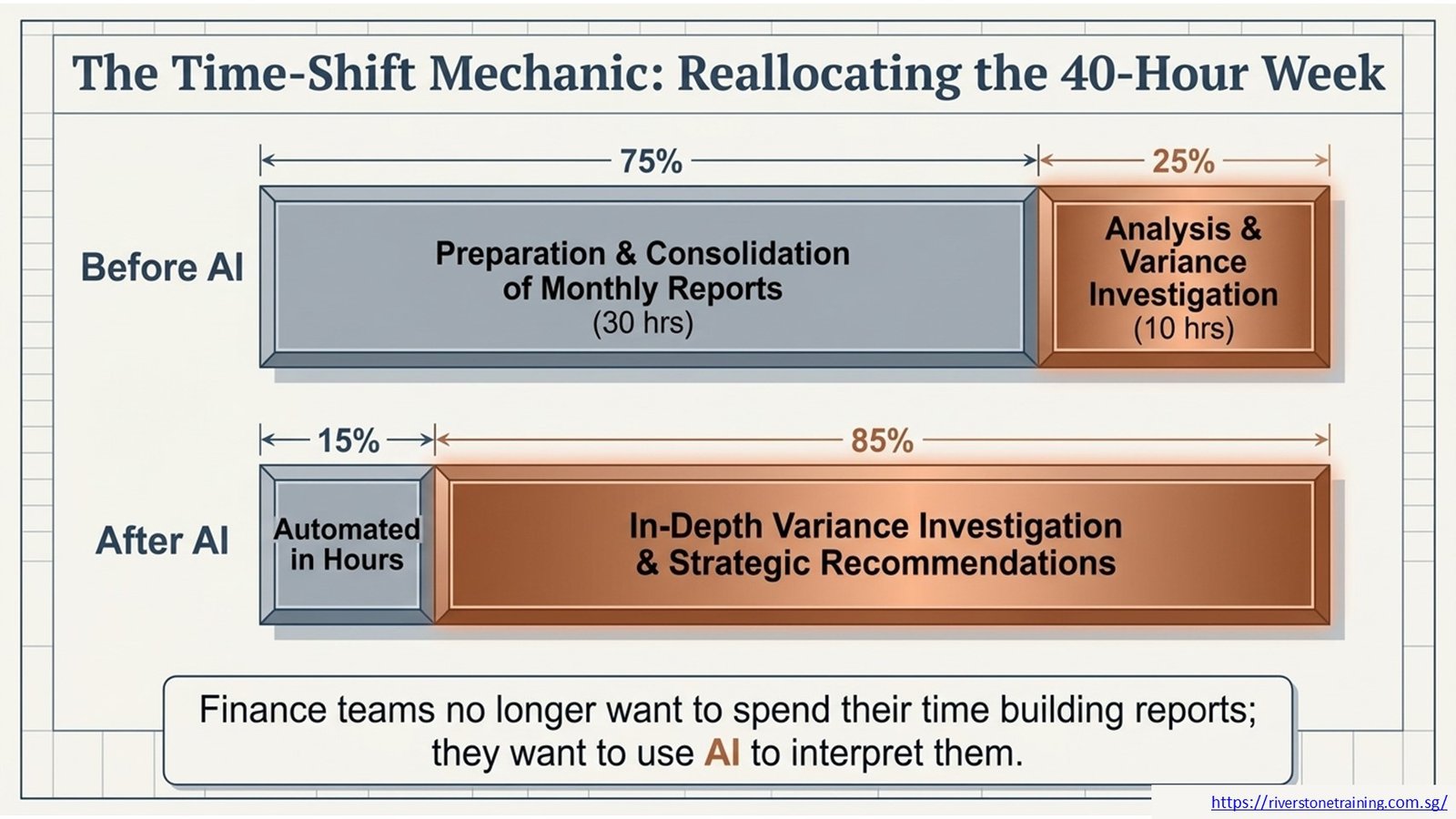
AI is reshaping the financial landscape by its ability to analyze vast quantities of financial data at unprecedented speed, allowing professionals to devote more time to analysis and strategy. The transition is changing the expectations of finance teams.

Finance professionals don’t want to spend as much time putting reports together as they do using AI to interpret the results and then communicate them as recommendations for the business. A team responsible for hours spent on consolidating monthly reports can now get the same work done in hours and save that time for more in-depth variance investigation. 

How Does AI Improve Financial Analysis?

AI can assist in financial analysis by recognizing trends and irregularities in vast amounts of data, which would be challenging to do manually. The machine learning models are able to flag unusual transactions, trends, or outliers for further review in a much quicker time frame than a manual line-by-line review.

This is no excuse for lack of analytical ability, but rather a call to change its focus from analysis to interpretation. An AI-flagged anomaly still requires financial knowledge to decide if the flagged transaction is an error or fraud or if it was a legitimate one-time event. 

Common AI applications used in finance, and the business benefit each one provides, are outlined below:

AI Application Business Benefit
Financial Forecasting Improves planning accuracy
Fraud Detection Identifies unusual transactions
Financial Reporting Automates repetitive processes
Risk Analysis Supports better-informed decisions

How Can AI Support Corporate Finance Decisions?
AI in Accounting and Finance

AI can be used to create financial models that simulate various scenarios to help the business team assess the financial consequences of a range of strategic options before investing resources. This is particularly beneficial for capital allocation and investment planning.

In addition, AI can identify risks that may not be apparent in a traditional scenario analysis, such as sensitivity to a particular cost driver. Corporate finance teams still have the final say but with a wider and quicker perspective on possible outcomes. 

Which Finance Tasks Can AI Automate?

AI can automate data entry, transaction categorization and reconciliation, and the creation of regular financial reports. These tasks are repetitive, rule-based, and are ideally suited to automation, thus minimizing manual errors and processing time.

Higher levels of automation involve the creation of the narrative in financial reports, or the creation of initial budget forecasts. For example, a team of accountants can use automation to perform monthly reconciliation checks which would normally have taken a number of days to complete each month manually. 

The table below compares traditional finance tasks with how AI enhances them:

Traditional Task AI Enhancement
Data Entry Automated processing
Financial Analysis Faster, pattern-based insights
Budgeting Predictive forecasting
Reporting Automated summaries and drafts

How Does AI Improve Financial Forecasting?
AI in Accounting and Finance

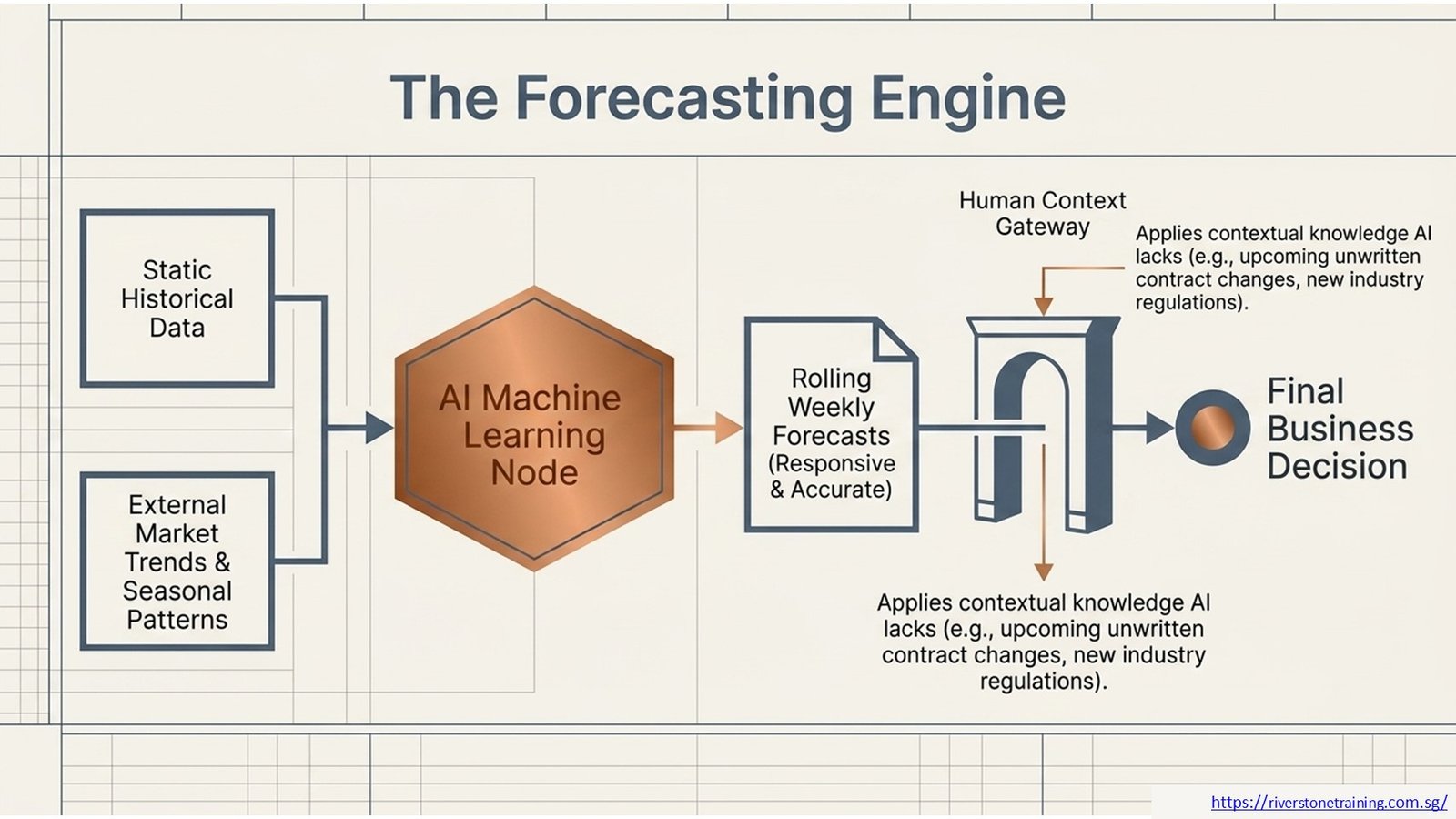
By leveraging historical data and other external factors like market trends or seasonal patterns, AI can enhance financial forecasting and create more nuanced, accurate predictive models. This gives more responsive forecasts in response to change than a static formula spreadsheet.

Another benefit of predictive analytics is that FP&A departments can perform rolling forecasts more often without a commensurate increase in effort. For instance, AI-powered forecasting can help a retail finance team adjust their demand projections on a weekly basis rather than once a year. 

Why Is Human Judgment Still Important?

While AI can generate outputs that appear convincing, it is crucial to still have human oversight to ensure that the data is complete and accurate and that the model is not biased. The output needs to be validated by finance professionals before it is used to make business decisions.

As well, AI does not have the same contextual knowledge of a particular client, industry regulation, or a business that a well-experienced professional would bring to a decision. A statistically sound forecast might not consider a known upcoming contract change that only a human reviewer would know about. 

How Can Finance Professionals Use AI Responsibly?

AI can be used responsibly by finance professionals by being aware of the limitations of the models on which they are relying and by making sure that there is clear oversight of the outputs that are automatically generated by AI and that they are not used in reporting or decision-making without understanding them. This includes the documentation of the use of AI within existing controls.

Another aspect of AI governance is reflecting on data privacy, model bias, and ethical concerns related to automated decisions, such as in credit scoring or fraud detection. AI governance structures that are established early and have governance structures around their usage tend to detect errors at an earlier stage and have higher trust among stakeholders. 

What AI Tools Are Commonly Used in Finance?

Some of the most popular AI applications in the finance sector include machine learning-driven forecasting solutions, report-generation AI assistants, and automated anomaly-detection features within accounting software. Many of these tools have now been integrated into enterprise resource planning (ERP) systems that are already in place.

This is where Generative AI can come into play, especially when it comes to writing comments on management reports or summarizing extensive financial documents. This is still drafted by finance teams, but they’re not doing so as much as they usually would, since it’s already written. 

How Do AI Courses Build Practical Finance Skills?

In AI courses, students are taught to apply AI to real-life accounting and finance situations in hands-on exercises, not just to study AI theory without practical applications. This ties technical concepts of AI to the practical aspects of finance.

Most students will have the opportunity to review AI-provided forecasts, correct faulty assumptions, and fast-track reporting cycles while under realistic time constraints with the help of AI tools. This develops the same judgment skills that are needed when using AI tools on the job. 

Core skills developed through this training, and their workplace value, are summarized below:

Skill Workplace Value
AI Literacy Work effectively with AI tools
Data Analytics Generate better financial insights
Critical Thinking Validate AI-generated outputs
Financial Modeling Improve decision-making accuracy

Which Industries Need AI-Ready Finance Professionals?

AI-powered tools are becoming essential in a variety of industries, such as banking, insurance, retail, manufacturing, and professional services, where finance professionals are increasingly expected to be proficient. Finance professionals have a growing need to be comfortable using AI-powered tools in various sectors, including banking, insurance, retail, manufacturing, and professional services. AI-powered finance capability is beneficial to any sector dealing with extensive transactions or predictive information.

In banking, AI has been used to a great extent for detecting fraud and credit risks, while in manufacturing, teams involved in finance rely on AI forecasting for inventory management and cost planning. In both scenarios, there is a need for finance professionals to interpret and take action on the AI’s output. 

How Does AI Improve Productivity Without Replacing Professionals?

AI enhances productivity by automating repetitive, high-volume tasks, allowing finance professionals to dedicate their time to more strategic and analysis-driven work, where human skills are still paramount. It’s a change in the way rather than the elimination of the role of finance professionals.

Well-executed AI implementations usually shift the hours saved to activities that provide more value to the organization, like scenario planning or business partnering with the operational team. That’s a reason why AI has become increasingly important for the finance industry rather than less. 

What Career Opportunities Benefit from AI Skills?

The integration of AI into tools used at every level of financial analysis makes it essential for all analysts, FP&A professionals, accountants, and corporate finance managers to learn how to use AI. Those who are comfortable with the use of AI-powered platforms are more likely to be promoted. 

Combining AI skills with a strong foundation from a corporate finance course strengthens both the technical and strategic sides of a finance career, since AI-generated insights still require sound financial judgment to apply effectively in business decisions.

The table below highlights how AI applies across common finance career paths:

Role AI Application
Financial Analyst Forecasting and scenario analysis
FP&A Analyst Budget automation
Accountant AI-assisted reporting
Corporate Finance Manager Strategic financial planning

Why Is Continuous Learning Important in AI-Driven Finance?
AI in Accounting and Finance

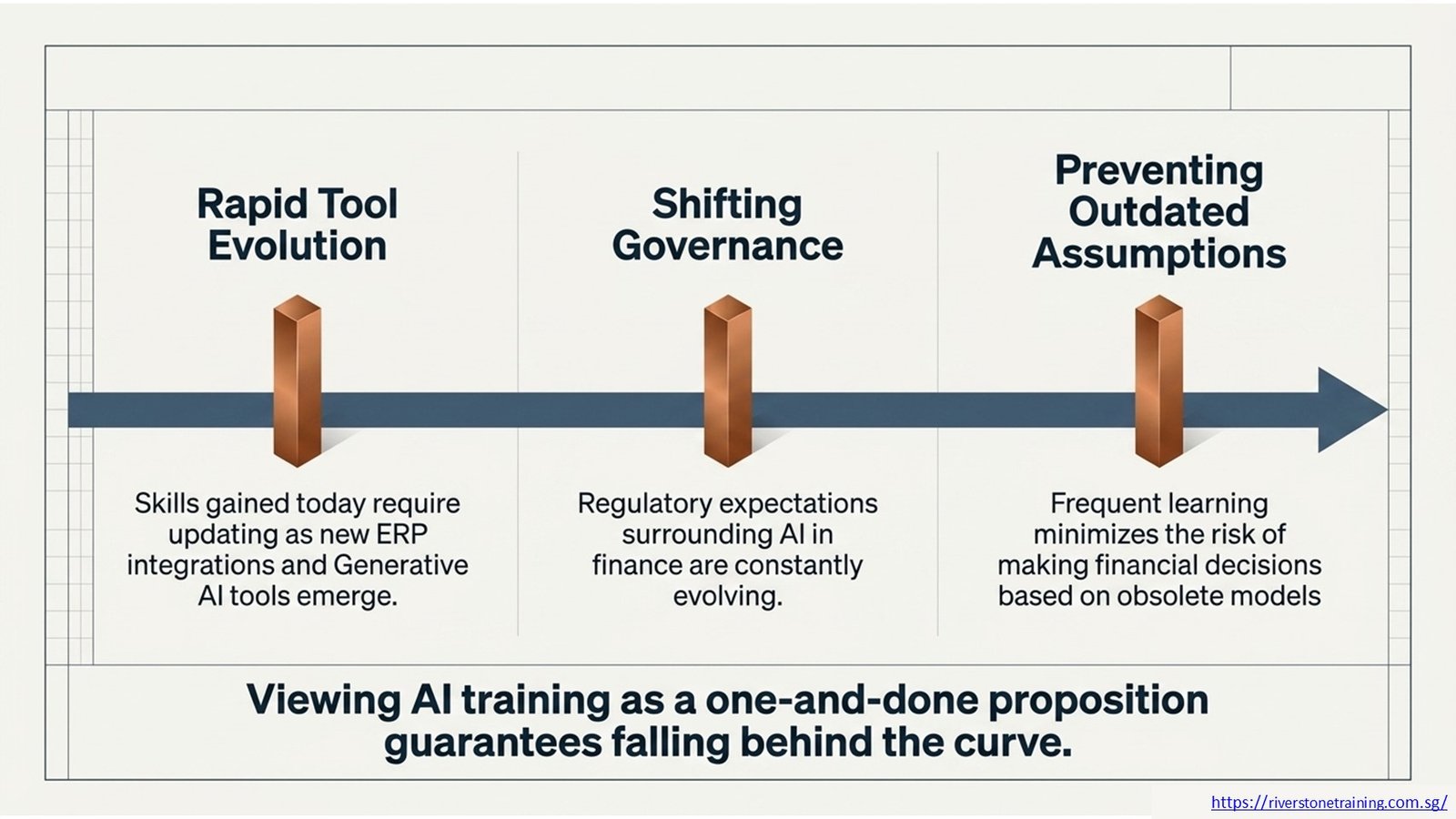
It’s crucial to continuous learning, as AI tools and capabilities are rapidly changing, and skills gained Today may require updating within the next year or two. However, those in the finance industry who view AI training as a one-and-done proposition may find themselves left behind the curve with the rise of new tools.

AI governance and regulatory expectations are constantly evolving as the use of AI in finance grows, and ongoing learning plays a vital role in keeping professionals up to date. Frequent updates ensure that professionals are confident and credible in their use of AI for actual financial decisions, and minimize the chance of using outdated assumptions about the capabilities and limitations of a specific AI tool. 

The summary below brings together the core capabilities an AI-focused finance education builds:

Capability Area Why It Matters
AI Literacy Enables effective use of finance AI tools
Financial Analysis Supports accurate interpretation of AI output
Forecasting Improves planning speed and accuracy
Governance and Ethics Ensures responsible AI use
Strategic Judgment Converts AI insight into business decisions

How Can Finance Professionals Stay Future-Ready?

Structured AI training can be complemented with ongoing skill acquisition in essential finance capabilities like financial modeling, budgeting, and strategic analysis, ensuring finance professionals remain future-ready. Technical skills are not enough, and financial skills are not enough in a world of AI in finance; a technical expert who is not fluent with AI can make decisions based on unverifiable outputs, and a financial expert who is not technically skilled in AI can make decisions based on unverifiable output.

Those who have been doing these tasks on a regular basis, but have also been practicing the use of AI tools and have a solid financial sense will be best suited to take the lead in adapting to the changing landscape of their work. The combination of AI skills and strong financial knowledge is a skill set that is increasingly in demand when employers are seeking candidates for analyst, FP&A, and corporate finance positions. 

Conclusion

AI courses equip finance experts with a blend of financial knowledge and proficiency in automation, data analysis, and AI-driven decision-making, ensuring they are ready for upcoming opportunities. This course empowers professionals to leverage AI for better financial analysis, forecasting, and reporting, without losing the human touch and judgment, a quality that AI cannot replace entirely.

An accounting or finance course with an AI component helps professionals leverage AI for various accounting and financial processes, whereas a course on corporate finance enhances strategic understanding of how to interpret AI-generated insights and use them to make informed business decisions. As the finance profession evolves and becomes increasingly competitive, finance professionals who keep on investing in both the evolution of AI and their own finance skills will position themselves well. 
Frequently Asked Questions

What is an AI in accounting and finance course?

AI in Accounting and Finance courses are courses that focus on teaching accounting and finance professionals about how to use AI tools to carry out fundamental accounting and finance functions like reporting, forecasting, and analysis. It will cover basic financial concepts and provide practical application through AI-powered software and workflow. 

AI is not expected to take over finance roles because it does repetitive, rule-based tasks but not the analytical thinking, strategic decision-making, and oversight that are essential in finance. Rather, AI is transforming the focus of finance professionals, allowing them to allocate more time to interpretation and decision-making. 

The most beneficial AI skills for finance careers include AI literacy, data analytics, critical thinking, and financial modeling. These skills enable professionals to engage with AI tools and ensure that their outputs are validated and that they use good financial judgment in interpreting the results.

Automating data consolidation, identifying anomalies, and generating sections of financial reports are some ways AI streamlines financial reporting, saving time and effort in manual preparation. These reports are still further reviewed and approved by financial professionals to guarantee that they are accurate and up to the reporting standards.

The finance professional should study AI, as it’s getting integrated into the tools and processes of reporting, forecasting and analysis function. Candidates who are well-versed in the workings of AI are more likely to have better career prospects in the field of finance as it continues to move into a digital era.

Yes, non-technical finance professionals can acquire practical AI skills without coding skills, as the majority of AI in accounting and finance courses emphasize the use of existing AI tools for finance-related tasks instead of coding AI systems from scratch. The focus is not on the development of software.

By incorporating AI in accounting and finance courses, finance professionals can equip themselves with the skills necessary to thrive in the future, where AI will increasingly influence the role.An AI in accounting and finance course empowers finance professionals with the tools to excel in the future, where the role is increasingly shaped by AI. This training enables professionals to operate more efficiently with emerging technologies and not be replaced by these technologies. 

What Is an AI in Accounting and Finance Course?

An ai in accounting and finance course is structured training that teaches finance and accounting professionals how to apply artificial intelligence tools to real workplace tasks, including reporting, forecasting, and analysis. It brings together essential finance concepts and real-world experience with AI-driven software tools and processes.

These courses don’t focus solely on AI as a technical discipline but instead embed it into current finance operations. For instance, a learner could create a first draft of a variance analysis using an AI tool and then interpret and refine the analysis using professional judgment. 

Why Is AI Transforming the Finance Profession?

AI is reshaping the financial landscape by its ability to analyze vast quantities of financial data at unprecedented speed, allowing professionals to devote more time to analysis and strategy. The transition is changing the expectations of finance teams.

Finance professionals don’t want to spend as much time putting reports together as they do using AI to interpret the results and then communicate them as recommendations for the business. A team responsible for hours spent on consolidating monthly reports can now get the same work done in hours and save that time for more in-depth variance investigation. 

How Does AI Improve Financial Analysis?

AI can assist in financial analysis by recognizing trends and irregularities in vast amounts of data, which would be challenging to do manually. The machine learning models are able to flag unusual transactions, trends, or outliers for further review in a much quicker time frame than a manual line-by-line review.

This is no excuse for lack of analytical ability, but rather a call to change its focus from analysis to interpretation. An AI-flagged anomaly still requires financial knowledge to decide if the flagged transaction is an error or fraud or if it was a legitimate one-time event. 

Common AI applications used in finance, and the business benefit each one provides, are outlined below:

AI Application Business Benefit
Financial Forecasting Improves planning accuracy
Fraud Detection Identifies unusual transactions
Financial Reporting Automates repetitive processes
Risk Analysis Supports better-informed decisions

How Can AI Support Corporate Finance Decisions?

AI in Accounting and Finance

AI can be used to create financial models that simulate various scenarios to help the business team assess the financial consequences of a range of strategic options before investing resources. This is particularly beneficial for capital allocation and investment planning.

In addition, AI can identify risks that may not be apparent in a traditional scenario analysis, such as sensitivity to a particular cost driver. Corporate finance teams still have the final say but with a wider and quicker perspective on possible outcomes. 

Which Finance Tasks Can AI Automate?

AI can automate data entry, transaction categorization and reconciliation, and the creation of regular financial reports. These tasks are repetitive, rule-based, and are ideally suited to automation, thus minimizing manual errors and processing time.

Higher levels of automation involve the creation of the narrative in financial reports, or the creation of initial budget forecasts. For example, a team of accountants can use automation to perform monthly reconciliation checks which would normally have taken a number of days to complete each month manually. 

The table below compares traditional finance tasks with how AI enhances them:

Traditional Task AI Enhancement
Data Entry Automated processing
Financial Analysis Faster, pattern-based insights
Budgeting Predictive forecasting
Reporting Automated summaries and drafts

How Does AI Improve Financial Forecasting?

AI in Accounting and Finance

By leveraging historical data and other external factors like market trends or seasonal patterns, AI can enhance financial forecasting and create more nuanced, accurate predictive models. This gives more responsive forecasts in response to change than a static formula spreadsheet.

Another benefit of predictive analytics is that FP&A departments can perform rolling forecasts more often without a commensurate increase in effort. For instance, AI-powered forecasting can help a retail finance team adjust their demand projections on a weekly basis rather than once a year. 

Why Is Human Judgment Still Important?

While AI can generate outputs that appear convincing, it is crucial to still have human oversight to ensure that the data is complete and accurate and that the model is not biased. The output needs to be validated by finance professionals before it is used to make business decisions.

As well, AI does not have the same contextual knowledge of a particular client, industry regulation, or a business that a well-experienced professional would bring to a decision. A statistically sound forecast might not consider a known upcoming contract change that only a human reviewer would know about. 

How Can Finance Professionals Use AI Responsibly?

AI can be used responsibly by finance professionals by being aware of the limitations of the models on which they are relying and by making sure that there is clear oversight of the outputs that are automatically generated by AI and that they are not used in reporting or decision-making without understanding them. This includes the documentation of the use of AI within existing controls.

Another aspect of AI governance is reflecting on data privacy, model bias, and ethical concerns related to automated decisions, such as in credit scoring or fraud detection. AI governance structures that are established early and have governance structures around their usage tend to detect errors at an earlier stage and have higher trust among stakeholders. 

What AI Tools Are Commonly Used in Finance?

Some of the most popular AI applications in the finance sector include machine learning-driven forecasting solutions, report-generation AI assistants, and automated anomaly-detection features within accounting software. Many of these tools have now been integrated into enterprise resource planning (ERP) systems that are already in place.

This is where Generative AI can come into play, especially when it comes to writing comments on management reports or summarizing extensive financial documents. This is still drafted by finance teams, but they’re not doing so as much as they usually would, since it’s already written. 

How Do AI Courses Build Practical Finance Skills?

In AI courses, students are taught to apply AI to real-life accounting and finance situations in hands-on exercises, not just to study AI theory without practical applications. This ties technical concepts of AI to the practical aspects of finance.

Most students will have the opportunity to review AI-provided forecasts, correct faulty assumptions, and fast-track reporting cycles while under realistic time constraints with the help of AI tools. This develops the same judgment skills that are needed when using AI tools on the job. 

Core skills developed through this training, and their workplace value, are summarized below:

Skill Workplace Value
AI Literacy Work effectively with AI tools
Data Analytics Generate better financial insights
Critical Thinking Validate AI-generated outputs
Financial Modeling Improve decision-making accuracy

Which Industries Need AI-Ready Finance Professionals?

AI-powered tools are becoming essential in a variety of industries, such as banking, insurance, retail, manufacturing, and professional services, where finance professionals are increasingly expected to be proficient. Finance professionals have a growing need to be comfortable using AI-powered tools in various sectors, including banking, insurance, retail, manufacturing, and professional services. AI-powered finance capability is beneficial to any sector dealing with extensive transactions or predictive information.

In banking, AI has been used to a great extent for detecting fraud and credit risks, while in manufacturing, teams involved in finance rely on AI forecasting for inventory management and cost planning. In both scenarios, there is a need for finance professionals to interpret and take action on the AI’s output. 

How Does AI Improve Productivity Without Replacing Professionals?

AI enhances productivity by automating repetitive, high-volume tasks, allowing finance professionals to dedicate their time to more strategic and analysis-driven work, where human skills are still paramount. It’s a change in the way rather than the elimination of the role of finance professionals.

Well-executed AI implementations usually shift the hours saved to activities that provide more value to the organization, like scenario planning or business partnering with the operational team. That’s a reason why AI has become increasingly important for the finance industry rather than less. 

What Career Opportunities Benefit from AI Skills?

The integration of AI into tools used at every level of financial analysis makes it essential for all analysts, FP&A professionals, accountants, and corporate finance managers to learn how to use AI. Those who are comfortable with the use of AI-powered platforms are more likely to be promoted. 

Combining AI skills with a strong foundation from a corporate finance course strengthens both the technical and strategic sides of a finance career, since AI-generated insights still require sound financial judgment to apply effectively in business decisions.

The table below highlights how AI applies across common finance career paths:

Role AI Application
Financial Analyst Forecasting and scenario analysis
FP&A Analyst Budget automation
Accountant AI-assisted reporting
Corporate Finance Manager Strategic financial planning

Why Is Continuous Learning Important in AI-Driven Finance?

AI in Accounting and Finance

It’s crucial to continuous learning, as AI tools and capabilities are rapidly changing, and skills gained Today may require updating within the next year or two. However, those in the finance industry who view AI training as a one-and-done proposition may find themselves left behind the curve with the rise of new tools.

AI governance and regulatory expectations are constantly evolving as the use of AI in finance grows, and ongoing learning plays a vital role in keeping professionals up to date. Frequent updates ensure that professionals are confident and credible in their use of AI for actual financial decisions, and minimize the chance of using outdated assumptions about the capabilities and limitations of a specific AI tool. 

The summary below brings together the core capabilities an AI-focused finance education builds:

Capability Area Why It Matters
AI Literacy Enables effective use of finance AI tools
Financial Analysis Supports accurate interpretation of AI output
Forecasting Improves planning speed and accuracy
Governance and Ethics Ensures responsible AI use
Strategic Judgment Converts AI insight into business decisions

How Can Finance Professionals Stay Future-Ready?

Structured AI training can be complemented with ongoing skill acquisition in essential finance capabilities like financial modeling, budgeting, and strategic analysis, ensuring finance professionals remain future-ready. Technical skills are not enough, and financial skills are not enough in a world of AI in finance; a technical expert who is not fluent with AI can make decisions based on unverifiable outputs, and a financial expert who is not technically skilled in AI can make decisions based on unverifiable output.

Those who have been doing these tasks on a regular basis, but have also been practicing the use of AI tools and have a solid financial sense will be best suited to take the lead in adapting to the changing landscape of their work. The combination of AI skills and strong financial knowledge is a skill set that is increasingly in demand when employers are seeking candidates for analyst, FP&A, and corporate finance positions. 

Conclusion

AI courses equip finance experts with a blend of financial knowledge and proficiency in automation, data analysis, and AI-driven decision-making, ensuring they are ready for upcoming opportunities. This course empowers professionals to leverage AI for better financial analysis, forecasting, and reporting, without losing the human touch and judgment, a quality that AI cannot replace entirely.

An accounting or finance course with an AI component helps professionals leverage AI for various accounting and financial processes, whereas a course on corporate finance enhances strategic understanding of how to interpret AI-generated insights and use them to make informed business decisions. As the finance profession evolves and becomes increasingly competitive, finance professionals who keep on investing in both the evolution of AI and their own finance skills will position themselves well. 

Frequently Asked Questions

What is an AI in accounting and finance course?

AI in Accounting and Finance courses are courses that focus on teaching accounting and finance professionals about how to use AI tools to carry out fundamental accounting and finance functions like reporting, forecasting, and analysis. It will cover basic financial concepts and provide practical application through AI-powered software and workflow. 

AI is not expected to take over finance roles because it does repetitive, rule-based tasks but not the analytical thinking, strategic decision-making, and oversight that are essential in finance. Rather, AI is transforming the focus of finance professionals, allowing them to allocate more time to interpretation and decision-making. 

The most beneficial AI skills for finance careers include AI literacy, data analytics, critical thinking, and financial modeling. These skills enable professionals to engage with AI tools and ensure that their outputs are validated and that they use good financial judgment in interpreting the results.

Automating data consolidation, identifying anomalies, and generating sections of financial reports are some ways AI streamlines financial reporting, saving time and effort in manual preparation. These reports are still further reviewed and approved by financial professionals to guarantee that they are accurate and up to the reporting standards.

The finance professional should study AI, as it’s getting integrated into the tools and processes of reporting, forecasting and analysis function. Candidates who are well-versed in the workings of AI are more likely to have better career prospects in the field of finance as it continues to move into a digital era.

Yes, non-technical finance professionals can acquire practical AI skills without coding skills, as the majority of AI in accounting and finance courses emphasize the use of existing AI tools for finance-related tasks instead of coding AI systems from scratch. The focus is not on the development of software.

Related Posts

Everything You Need to Know About Finance Courses

Advance your career with Riverstone’s expert-led finance courses. Get in touch with us now.