Python for Finance and Financial Modeling
Finance has been a profession that is always data-driven. Decisions to the tune of millions of dollars are informed by the spreadsheets, number crunching and model-generating activities of analysts who have taken decades to create their models. However, there has been a fundamental change in the last decade. The amount of financial data has increased exponentially, demands on analysts have been raised significantly and the same tools previously used to define the profession (primarily, Excel) are no longer enough on their own. Python has come in to fill the void, and has done so with incredible rapidity.
Junior and mid-level finance professionals, or those seeking to join the industry, no longer consider learning Python a differentiator- it is a more and more expected requirement. All investment banks, asset managers, corporate finance teams and fintech companies are seeking professionals who can do more than create a formula. They prefer individuals who are able to clean massive data sets, create reproducible models, automate repetitive reporting and effectively communicate quantitative results. All this is made possible by Python, which is readable, flexible and with one of the biggest developer communities in the world.
This article investigates the applications of Python in the real world of finance and financial modelling, how competence in the language is developed, the obstacles which practitioners encounter on the way and what knowledge experienced practitioners would like to know at a younger age. Regardless of whether you are looking to take a Python course in finance or are already halfway through one, this guide provides grounded, practical insight into how Python fits into current finance careers.
What Python Brings to Finance That Spreadsheets Cannot
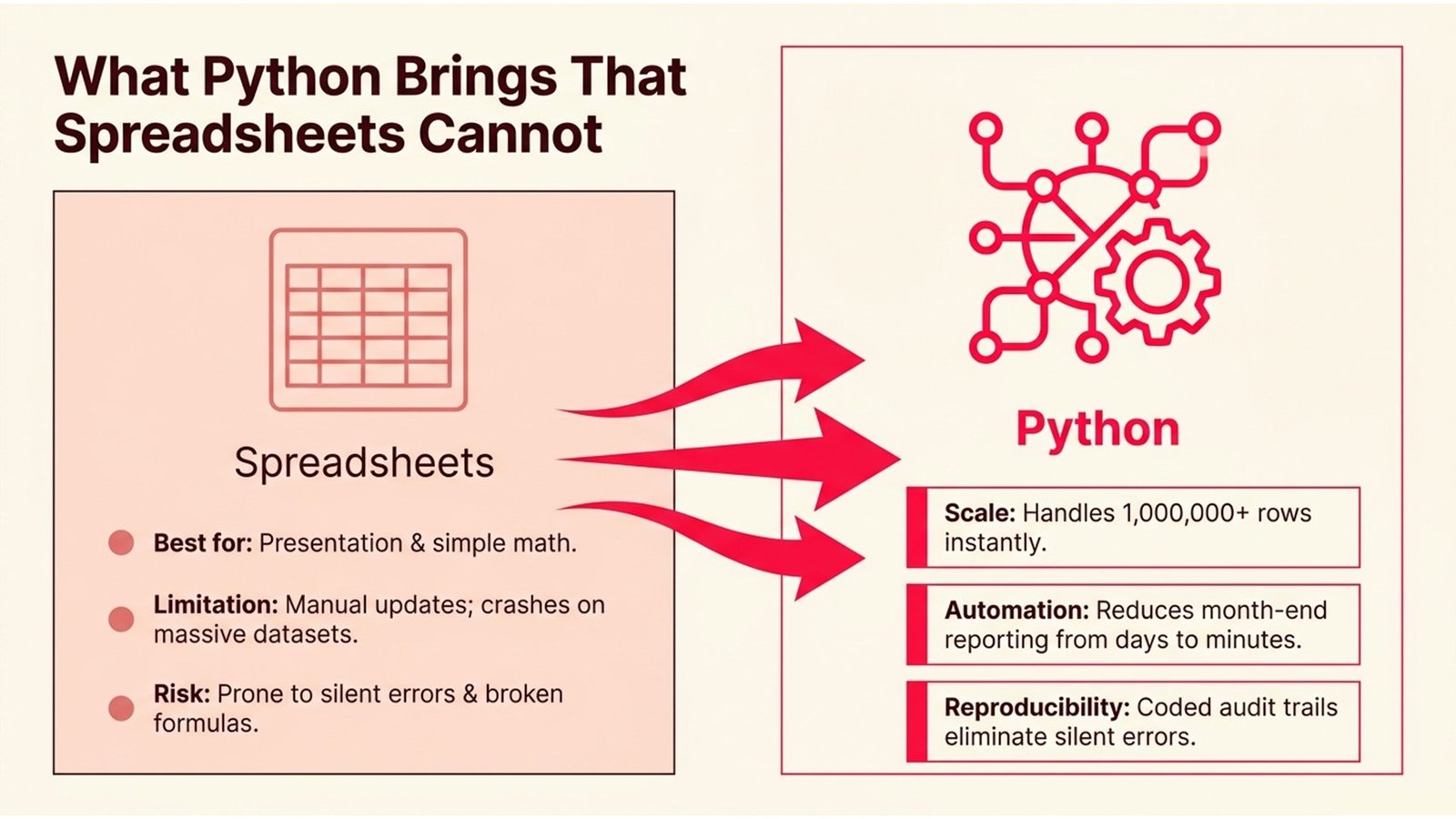
Python and finance: Python is not about wholesale replacement of Excel. Spreadsheets are still a medium of communication, a presentation interface and a very suitable platform to make simple calculations. The Python argument concerns what occurs when the task becomes more than can be handled in a spreadsheet. A million rows in a dataset, thousands of simulation instances required by a model, a report that must be regenerated exactly every month, and no human involvement are some of the places Python deserves to be.
Automation is one of the most direct benefits of Python in finance. Take a case of the month-end reporting in a mid-sized company. It can take a finance analyst two or three days to retrieve information in various systems, clean it, recalculate it and paste it on a set of templates. It only takes a few minutes to script that same process in Python. The analyst will not vanish, he/she will shift their time to interpretation, analysis and advisory work- the real value. The outcomes of firms that have invested in upskilling their staff are measurable improvements in efficiency and staff morale.
Financial modelling can also be done with Python using a more rigorous, more reproducible method than what can be done in a spreadsheet. All assumptions, transformations and calculations are coded in a Python environment and can be reviewed, tested, and version-controlled. This is significant in regulated businesses where audit trails play a crucial role. It is also important in investing situations where the errors of a model can cost money. A properly designed Python model can be more easily handed over, can be more easily updated, and is much less susceptible to the types of silent errors – broken cell references, overwritten formulas – that have led to the expensive errors in workflows based on Excel.
Core Applications of Python in Financial Modelling
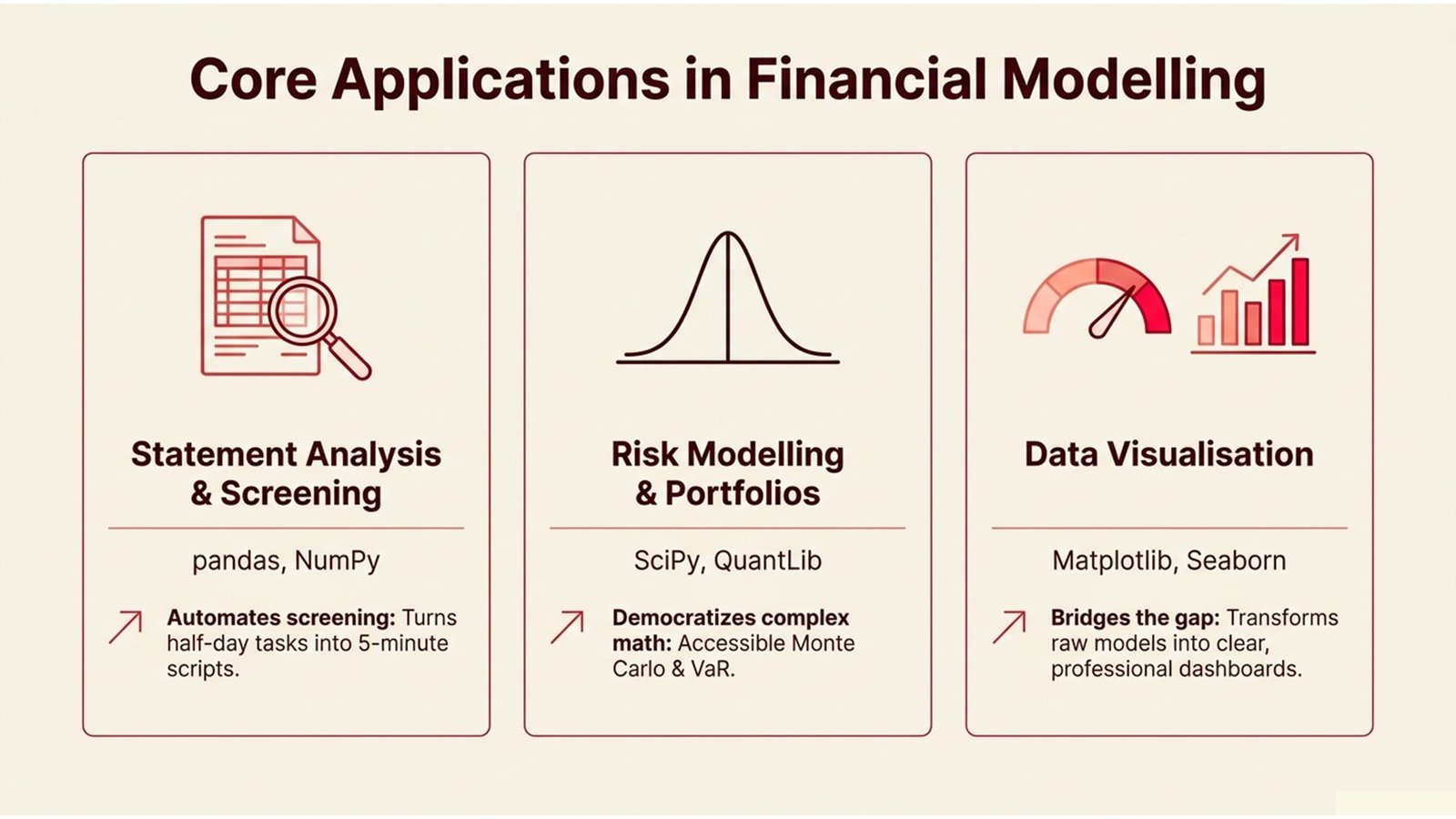
Python has a wide range of applications in finance, which are concentrated around a few high-value applications. Knowledge of these assists professionals in selecting the area they should concentrate on and the placement of Python skills in a job-finding or career-development discussion.
The most common entry point is perhaps financial statement analysis and modelling. With libraries such as pandas and NumPy, a finance specialist can import income statements, balance sheets, and cash flow information, compute financial metrics, construct dynamic projections and perform sensitivity analysis, all within a script that can be reused and updated. An example is a junior analyst at one of the European private equity companies who automated the first-stage financial screening of acquisitions with Python. What used to take half a day per company was cut down to less than five minutes, enabling the team to screen four times the number of opportunities within the same amount of time.
Another area of major usage is risk modelling and portfolio analysis. The scientific computing ecosystem of Python, NumPy, SciPy and specialised finance libraries, such as QuantLib, is very well adapted to solving problems such as Value at Risk calculations, Monte Carlo simulations, and optimisation of portfolios. These are techniques that used to be the preserve of quantitative analysts with advanced mathematics backgrounds, but with accessible tooling have become accessible to analysts who invest in the appropriate training. This is one of the major transformations that the profession has experienced in recent history, through the democratisation of quantitative finance.
Table 1: Key Python Libraries Used in Finance
| Library | Primary Use in Finance | Skill Level to Start |
| pandas | Data manipulation, financial statement, time series analysis. | Beginner |
| NumPy | Calculations, array manipulations, statistics. | Beginner |
| Matplotlib / Seaborn | Visualisation of data, charting of financial data and model outputs. | Beginner |
| SciPy | Statistical analysis, optimisation, numerical integration. | Intermediate |
| QuantLib | Derivative pricing, interest rate modelling, risk analytics | Advanced |
| scikit-learn | Credit scoring, fraud detection and forecasting through machine learning. | Intermediate |
A third aspect where Python can be of great importance in finance is data visualisation. The art of transferring the output of a financial model to non-technical users is in itself a skill, and Python visualisation packages, such as Matplotlib, Seaborn and Plotly, can enable analysts to create unambiguous, professional charts and dashboards, which far outstrip what Excel can produce without a lot of manual work. A modeler who can present his or her results in an impressive way is much more valuable than a modeler who is able to do the same but cannot build a model.
Five Steps to Building Python Skills for a Finance Career
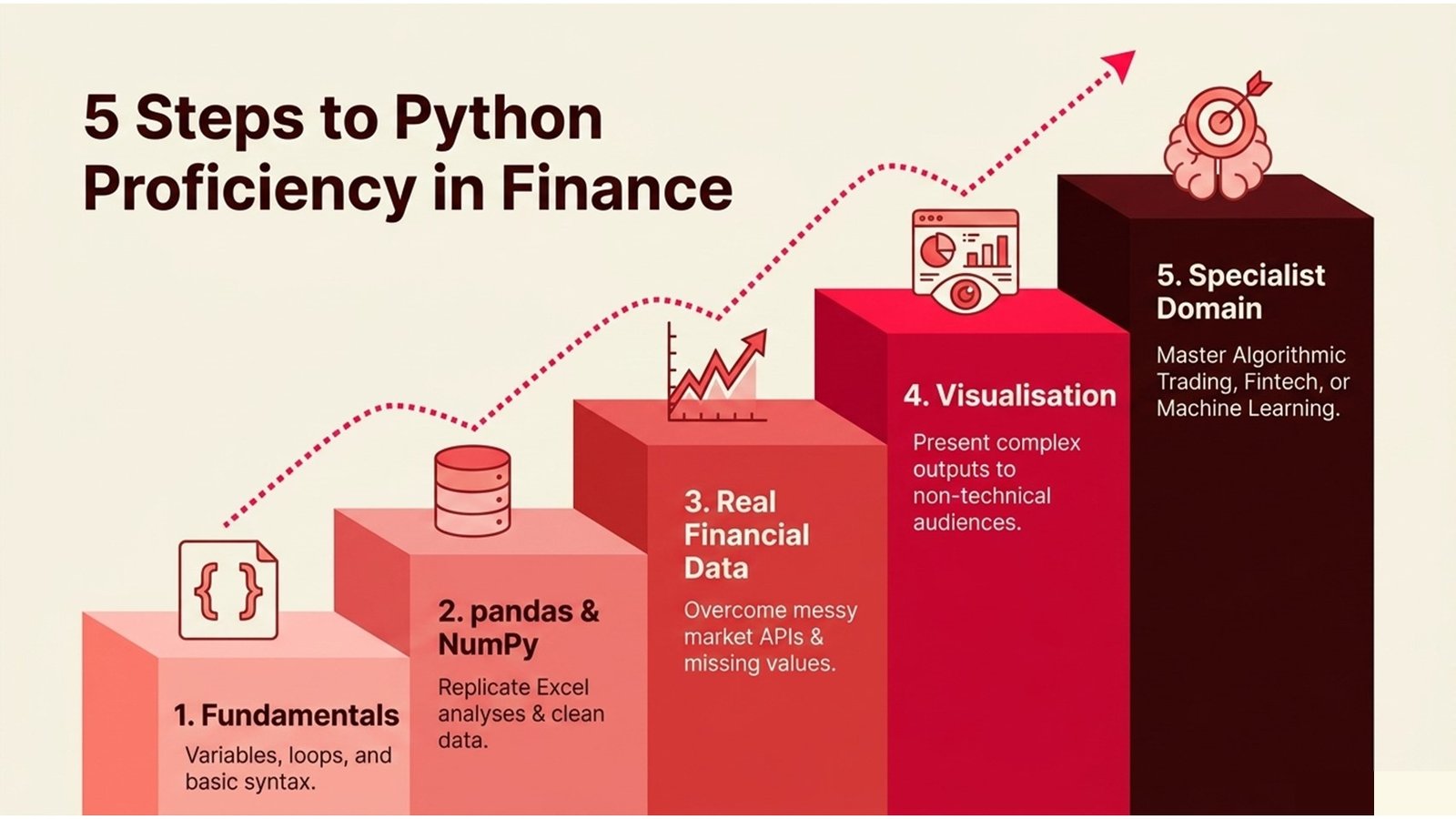
Becoming a Python-competent finance professional is not like becoming a software engineer. The aim is not a command of the complete language but, instead, useful, fluent knowledge of the sections of Python that are directly relevant to financial work. The five steps that follow are a realistic, chronological process towards such fluency.
Table 2: Five Steps to Python Proficiency for Finance Professionals
| Step | Focus Area | Practical Outcome |
| Learn Python fundamentals | Variables, types of data, loops, functions, conditionals | Understand simple scripts written and read without difficulty. |
| Master pandas and NumPy | DataFrames, data cleaning, arithmetic, and merging data. | Can replicate Excel financial analyses in Python |
| Apply to real financial data | Pull market data (e.g., Yahoo Finance API), model cash flows | Develops Python projects that are finance-specific. |
| Add visualisation skills | Plotly or Seaborn or Matplotlib charts and dashboards. | Can present model outputs to non-technical audiences |
| Explore a specialist domain | Financial risk modelling/financial algorithmic trading/financial machine learning. | Creates a niche, which can set you apart in the job market. |
The initial one, the introduction to the basics of Python, is what people overestimate the investment in the least. Making the jump to finance-specific apps is alluring, but unless one has the basics of how Python processes data structures, loops and functions, it becomes easy to stop making progress very fast when something goes wrong. An introductory Python finance course will normally start with two or three weeks of standard Python, and then move on to libraries in finance. Such a base yields especially over the remainder of the learning process.
The third step, using Python to actual financial data, is where the learning curve steepens the most. Using real market prices, real financial statements or real portfolio data are complicating factors absent in practice exercises: missing values, odd date formats, data that will arrive in the wrong format, APIs that will produce unforeseen results. Sailing through these complications is not an enjoyable process, yet it is precisely in this type of problem-solving that we become truly competent. Those professionals who omit this step and continue their training using structured exercises, as a rule, are unable to transfer their skills to an actual working environment without being dirty.
It takes the fifth step to explore a specialist domain to make the difference between a typical Python user and a finance professional, with a clear advantage. To others, it may imply entering into quantitative risk management. To some others, it could be understanding how Python is used in the algorithms of trading, or how machine learning methods are being employed to enhance credit scoring systems. Fintech and digital finance courses is starting to encompass these specialist applications in addition to a basic course in Python, as employers in financial technology companies at the growth stage desire job applicants who can both learn how to operate these tools and grasp the business aspects of their application.
Process Flow 1: Building a Financial Model in Python — End-to-End Workflow
| Stage | Key Activities | Tools / Methods | Output |
| Data Acquisition | Load financial statements or market data via APIs, databases or CSV files. | pandas, requests, yfinance, openpyxl | Clean the raw dataset in a DataFrame |
| Data Cleaning | Clean up missing values, standardise, eliminate duplicates, and perform data type validation. | pandas, NumPy | Analysis-ready dataset |
| Model Construction | Build revenue projections, cost structures, cash flow models, or valuation outputs | pandas, NumPy, home grown functions. | Basic financial core model script. |
| Scenario Analysis | Elaborate assumptions, Monte Carlo simulation or sensitivity by variables. | NumPy, SciPy, itertools | Scenario output tables |
| Visualisation | Outputs of the chart include key revenue bridges, waterfall charts, and scenario distributions. | Matplotlib, Seaborn, Plotly | Presentation-ready visuals |
| Documentation & Review | Add code comments, structure into functions, version control, and peer review logic | Git, Jupyter notebooks | Reproducible, auditable model |
Challenges Practitioners Face and How They Overcome Them
There are special challenges to learning Python as a financial practitioner that do not exist when learning the language as a computer science student or software developer. Finance professionals are most often learning Python during their current workloads, i.e., learning is squeezed into narrow windows in time-constrained periods such as early mornings, lunch breaks or weekend sessions. This does not lend much to consistency, and it is an experience that is too close to both reality and frustration to be able to ask a colleague a question at eleven at night, and not to have one.
The second challenge is the disconnect between learning in a structured learning setting and the use of skills in an unstructured work setting. Numerous people take a Python course in finance and discover that the issues they encounter at work do not fit well into what they learned. Information comes in formats that they have never encountered. The outputs requested by colleagues in tools that involve the integration of knowledge that is not covered by the course. The learner-to-practitioner transition demands an ambiguity tolerance and a readiness to seek, test and, in some cases, imperfect solutions. The people who succeed during this stage usually have a hobby of creating marginal projects either out of school, such as side analysis, a personal finance dashboard, or a stock-screening application, that trains their problem-solving muscle in a low-stakes setting.
The third risk is the inability to cope with the fast-changing ecosystem. Python libraries are constantly changing, as are its best practices and the new tools it introduces. This is more so in places where Python is applied to financial technology. Fintech and digital finance courses that were developed three years ago might have already become the method of teaching that has been outpaced. Staying up-to-date practitioners are those practitioners who participate in professional communities: online forums, industry conferences, and industry newsletters, where practitioners discuss what is really working in the production context, and not what is presented in a tutorial.
Process Flow 2: From Python Learner to Finance Professional — Career Development Path
| Career Stage | Learning Focus | Recommended Activities | Milestone to Aim For |
| Beginner (0–3 months) | Introduction to Python, Introduction to pandas, Financial CSV data. | Financial Full course in Python; recreate a DCF model in Python. | First Python-written financial model. |
| Developing (3–6 months) | APIs, data visualisation, financial ratios, time series | Develop a project portfolio; help with automating team reporting. | Saved quantifiable time on an actual work activity. |
| Intermediate (6–12 months) | Scenario simulation, risk modelling, statistical analysis. | Take fintech and digital finance courses to put it in context. | Finished a Monte Carlo or VaR model of a real dataset. |
| Advanced (12+ months) | Machine learning in finance, algorithmic strategy, production-grade code | Mentor new learners; introduce Python projects inside or at conferences. | Being a Python resource in your finance team/firm. |
Real-World Cases and Lessons Learned
In various finance settings, e.g., investment banking, corporate treasury, asset management, and financial technology, professionals who have incorporated Python into their practices have remarkably common remarks on what they wish they had done differently.
A consumer goods company in the Netherlands that has a corporate treasury analyst remarked that during the first six months after taking a Python course in finance, she spent the time trying to automate her group’s cash forecasting model. The first attempt was successful on its own but failed when the source data was reformatted–which occurred quite often. Her lesson in the experience was that solid Python in finance would need nearly as much effort in data validation and error handling as it does in the underlying modelling logic. A model that gives beautiful results eighty percent of the time and crashes silently the remaining twenty percent is useless in a production environment. She took three months to rework the script with effective validation checks and eventually released a version that the team was confident with and used every day.
A different challenge was faced by an equity research associate of an asset management firm in Canada. His Python abilities were good enough to create an advanced earnings model, but he did not consider the time it would require to explain the process to those who were not familiar with code. The model remained idle after two months, as senior analysts were not sure how to interpret the results of the model. He eventually created a bare bones Excel front-end, which would read the output of the Python model- filling the gap between technical capability and organisational adoption. It is one of those moral lessons that come to mind over and over again, how technical skills can ensure the opportunity of better work, and communication skills can define whether the work is utilized or not.
A fintech startup in Germany employed a group of junior analysts who had undergone fintech and digital finance courses that were specifically created to include both Python programming and knowledge of financial products. The company discovered that the onboarding time of these hires was much less than that of the other employees, who either had a good background in finance but not in Python, or knew Python but not in a financial setting. This mix, financial literacy and technical fluency, is what the industry is now starting to directly compensate. It is this intersection that has led to the rise in demand for fintech and digital finance courses in such a drastic way: the courses are meant to create professionals with the ability to speak both languages, and the demand is responding.
Conclusion: Turning Python Skills into Career Momentum
Python has left behind its status as a specialist language of quantitative analysts in hedge funds and become a skill of relevance to anyone dealing with financial data. The question is no longer whether junior and mid-level finance professionals should learn Python, but how they should learn it in a manner that instills their real, transferable competence as opposed to superficial familiarity.
It is not necessarily the most strongly endowed programmers who have benefited most from Python in the field of finance. Those who realized what issues they were attempting to address took time to apply their abilities to actual information and presented their results in a manner that their peers and senior staff could rely on to trust. Technical skills are the admission ticket; judgment, communication, and domain knowledge determine the distance that the skills will bring you.
Out of all things discussed in this paper, three actionable insights can be distinguished. To start with, select a finance course in python which starts with real applications in finance, and does not spend months in general education about generic programming before it comes to finance. The desire to continue learning remains the greatest when you can achieve the professional relevance of each subject. Second, consider fintech and digital finance courses as an addition to the basic courses in Python, rather than an alternative to them. The finance context of these specialist programmes is necessary to understand the use of Python in digital lending, payment systems, or algorithmic trading. Third, make something real at the earliest opportunity. Automate a single task at your current job, model the financials of one company in Python, or create a dashboard which you use in real life. The early actual project will be more informative than any tutorial and will provide you with something tangible to talk about in your next job interview. The people in the financial field who are making the most progress now are those who did not wait until they felt prepared–they constructed, they demolished, they repaired them, and they continued.